
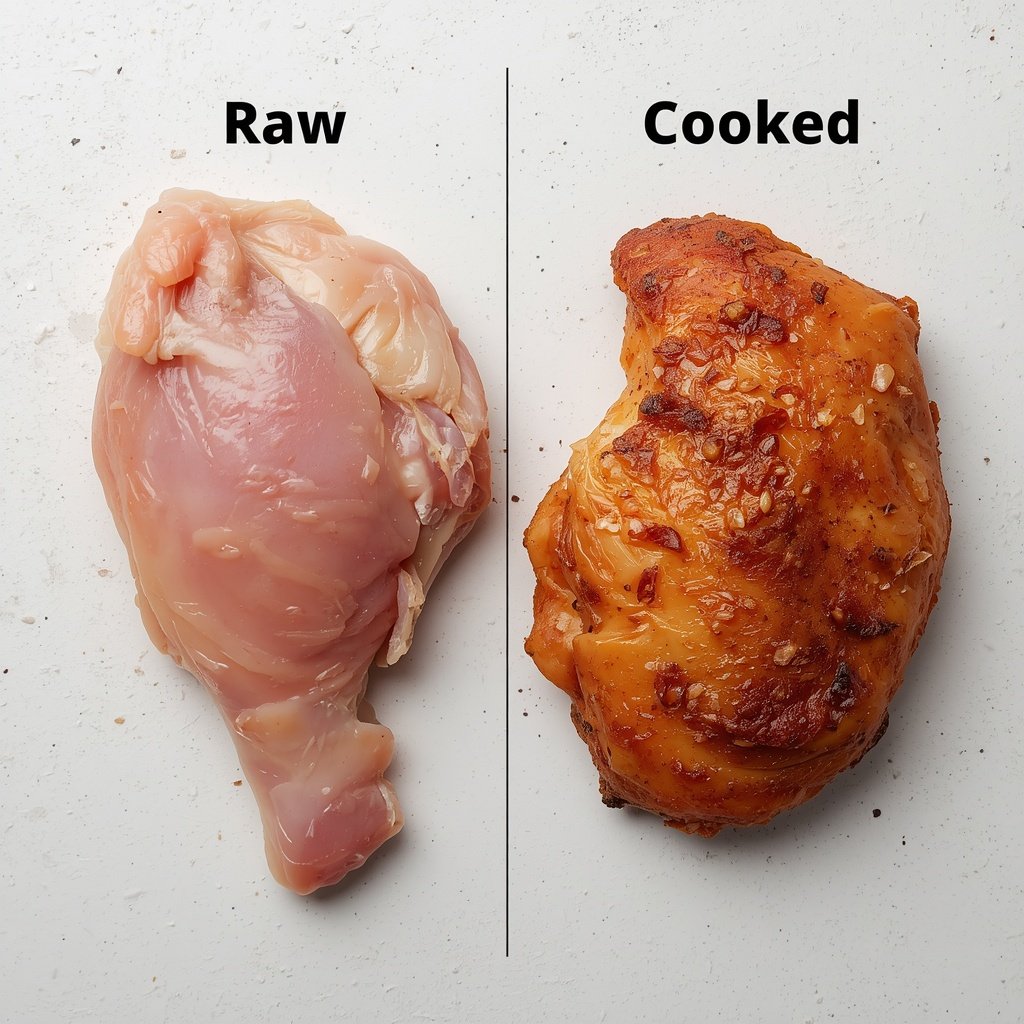
Quick Answer: Chicken thigh raw vs cooked weight comes down to about a 20–25% loss during cooking — slightly less shrinkage than chicken breast, since the extra fat in thigh meat helps retain moisture. A 150g raw thigh cooks down to around 115–120g, and a 100g raw portion becomes about 75–80g cooked. Use the calculator below to convert any weight.
Chicken Thigh Raw ↔ Cooked Weight Calculator
Type in either box — the other updates automatically. Bone-in thighs lose extra weight when the bone is removed after cooking, on top of this shrinkage.
Chicken Thigh Raw vs Cooked Weight Chart
| Raw Weight | Cooked Weight (Boneless) |
|---|---|
| 100g | ~75–80g |
| 150g | ~115–120g |
| 200g | ~155–160g |
| 250g | ~193–200g |
These figures assume boneless, skinless thigh meat. Bone-in thighs lose additional apparent weight once the bone is removed after cooking, which isn’t shrinkage at all — it’s just meat you were never going to eat in the first place.
Why Thighs Shrink Less Than Chicken Breast
Chicken breast typically loses 20–30% of its weight when cooked, often landing toward the higher end of that range because it’s a lean cut with almost no intramuscular fat to hold onto during cooking. Thigh meat has noticeably more fat marbled through it, and that fat renders slowly rather than evaporating the way water does, which is part of why thighs typically land at the lower end of the shrinkage range — closer to 20–25% rather than pushing past 30%.
This is also why overcooked thigh meat stays noticeably more forgiving than overcooked breast — there’s more fat left to keep it from drying out even several minutes past the ideal internal temperature.
Bone-In vs. Boneless Thighs
A bone-in, skin-on thigh weighs considerably more raw than a boneless, skinless one of the same size — often 30–40% more, once you account for the bone and skin. If you’re buying bone-in and removing the bone yourself after cooking, don’t apply the boneless shrinkage percentage to the whole raw weight, since a chunk of that starting weight was never going to become edible meat regardless of cooking method.
A rough adjustment: for bone-in, skin-on thighs, expect the final edible cooked meat to be closer to 55–60% of the raw bone-in weight, rather than the 75–80% figure that applies to boneless cuts.
Calories and Protein: Raw vs. Cooked Thigh
100g of raw boneless, skinless chicken thigh contains roughly 119 calories and 17g of protein. Once cooked, that same original 100g of raw meat (now weighing about 75–78g cooked) contains the same total protein, just concentrated into less weight — cooked chicken thigh runs closer to 209 calories and 26g of protein per 100g of the cooked product, since water loss during cooking packs the existing nutrients into a smaller portion.
Practical Examples
A standard grocery pack of boneless, skinless thighs (about 4 pieces, roughly 600g raw total) cooks down to approximately 460–475g of edible meat — enough for four modest single servings or three generous ones. A meal-prep batch of 1kg raw thighs yields close to 775g cooked, which is worth knowing before you portion out containers for the week based on the raw weight instead of the finished amount.
For a single dinner plate, a 200g raw thigh (a reasonably large one, or two smaller ones) becomes about 155g cooked — roughly the same finished portion as several slices of deli turkey stacked together, if you’re comparing poultry protein sources side by side. Keeping chicken thigh raw vs cooked weight in mind before you shop makes it much easier to buy the right amount for a recipe instead of guessing and coming up short.
If you’re building a protein target across a full day rather than one meal, pairing chicken thigh with other tracked sources — eggs at breakfast or shrimp at lunch — is easier when you know the cooked weight you’re actually working with, not just what went into the pan raw.
Frequently Asked Questions
A boneless chicken thigh loses about 20–25% of its weight when cooked, slightly less than chicken breast due to its higher fat content.
Yes. Chicken thighs typically lose 20–25% of their weight when cooked, compared to 20–30% for chicken breast, because the extra fat in thigh meat helps retain moisture.
A 150g raw boneless chicken thigh typically weighs about 115–120g once cooked.
The edible meat weighs less relative to the raw bone-in weight, but that’s mostly because the bone and skin were never edible weight to begin with — not additional cooking shrinkage.
100g of cooked boneless, skinless chicken thigh contains approximately 26g of protein, since cooking concentrates the protein that was already in the raw meat.
Weigh it raw when possible, since nutrition labels and most databases list values based on raw weight, making tracking more consistent.
Final Answer: Chicken Thigh Raw vs Cooked Weight
The short version of chicken thigh raw vs cooked weight is a 20–25% loss for boneless, skinless cuts — noticeably gentler than chicken breast, thanks to the extra fat that keeps the meat moister as it cooks. A 150g raw thigh becomes about 115–120g cooked, and that ratio holds fairly steady across grilling, baking, and pan-frying, with only a few percentage points of difference between methods. For bone-in thighs, remember to subtract for the bone and skin on top of that shrinkage before estimating your final edible portion.