
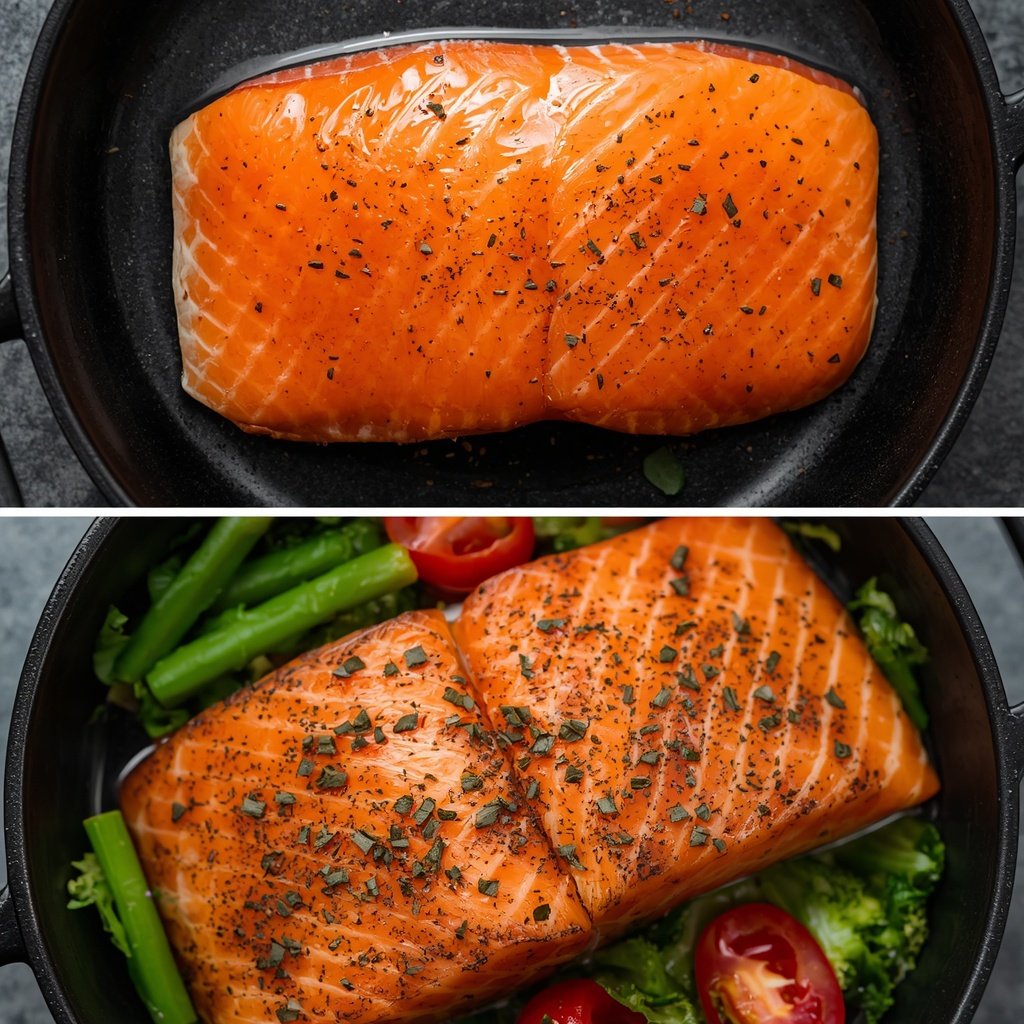
Quick Answer: Salmon raw vs cooked weight comes down to about a 15–25% loss during cooking — less shrinkage than most poultry, since salmon holds onto more of its natural fat and moisture. A 200g raw fillet (about 7oz) typically cooks down to roughly 160–170g, and a standard 6oz (170g) raw portion becomes about 130–140g cooked. Use the calculator below for your cooking method.
Salmon Raw ↔ Cooked Weight Calculator
Type in either box — the other updates automatically. Skin-on fillets and thicker cuts tend to shrink slightly less than thin, skinless portions.
Salmon Raw vs Cooked Weight by Method
| Cooking Method | Typical Shrinkage | 200g Raw Becomes |
|---|---|---|
| Poaching | ~12% | ~176g |
| Baking | ~17% | ~166g |
| Pan-searing | ~23% | ~154g |
| Grilling | ~25% | ~150g |
Poaching sits at the gentle end because the fish never gets hot enough to drive off much moisture — it’s essentially cooked through gentle heat transfer from the surrounding liquid. Grilling and pan-searing use direct, high heat that pushes more water out quickly, which is why those methods land at the higher end of the shrinkage range despite often being the tastier choice.
Why Fish Shrinks Less Than Poultry or Beef
Salmon’s muscle fibers are structured differently from land-animal meat — they’re shorter and organized in thin layers called myotomes, separated by connective tissue that breaks down easily with heat. This structure holds onto moisture more effectively than the longer muscle fibers in chicken breast, which is a big part of why fish generally loses less weight during cooking than poultry does, even accounting for cooking method.
Salmon’s naturally high fat content plays a role too — fattier fish like salmon and mackerel tend to shrink less than lean white fish like cod or tilapia, since the fat doesn’t evaporate the way water does.
Skin-On vs. Skinless Fillets
A skin-on fillet loses slightly less weight than a skinless one cooked the same way, since the skin acts as a barrier that slows moisture loss from that side of the fillet. The difference is modest — typically 2-3 percentage points — but it’s part of why restaurant-style pan-seared salmon (usually cooked skin-side down first) tends to stay juicier than a skinless fillet cooked the same way.
Fresh vs. Frozen-and-Thawed Salmon
Previously frozen salmon that’s been properly thawed cooks down to roughly the same shrinkage percentages as fresh salmon, though it will release slightly more liquid during thawing itself (separate from cooking loss). If you’re weighing thawed salmon for a recipe, pat it dry first — otherwise you may be including surface moisture in your “raw weight” that isn’t representative of the actual muscle tissue.
Practical Examples
A standard grocery-store salmon fillet, sold as a single portion, usually weighs between 170g and 200g raw. Baked at a moderate oven temperature, that becomes roughly 140–165g cooked — a meaningful difference from the raw weight printed on the package label, which is what most nutrition apps use as the default.
For meal prep, a whole side of salmon (often sold around 1kg raw) baked in one piece yields approximately 830g of cooked fish — enough for roughly five 165g cooked portions, which is a more useful number to plan around than the 1kg raw figure on the packaging. Knowing salmon raw vs cooked weight ahead of time is what makes portioning a whole side out for the week actually work instead of running short by Thursday.
100g of raw salmon contains about 208 calories and 20g of protein; once cooked, that same fish concentrates into roughly 80g, working out to about 260 calories and 25g of protein per 100g of the cooked product. If you’re comparing protein sources across a meal plan, salmon sits between leaner options like shrimp and fattier cuts like chicken breast or chicken thigh in terms of fat content, while still landing solidly in high-protein territory.
Frequently Asked Questions
Salmon typically loses 15–25% of its weight when cooked, depending on the method — poaching causes the least shrinkage, grilling the most.
Yes. Salmon typically loses 15–25% of its weight compared to 20–30% for chicken breast, largely due to its muscle structure and higher fat content.
A 200g raw salmon fillet typically weighs about 150–176g cooked, depending on the cooking method used.
Slightly. Skin-on fillets typically lose 2–3 percentage points less weight than skinless fillets cooked the same way, since the skin slows moisture loss.
100g of cooked salmon contains approximately 25g of protein, slightly more concentrated than raw salmon due to water loss during cooking.
Salmon is almost always sold and labeled by raw weight, so plan portions using raw weight and expect roughly 15–25% less once it’s cooked.
Final Answer: Salmon Raw vs Cooked Weight
Bringing it back to salmon raw vs cooked weight in one line: expect a 15–25% loss, with poaching landing near the bottom of that range and grilling near the top. A 200g raw fillet typically finishes somewhere between 150g and 176g depending on how it’s cooked, and skin-on cuts hold onto a couple extra percentage points of moisture compared to skinless. Since salmon is almost always sold and labeled by raw weight, planning meals around that starting number — and adjusting downward by roughly a fifth to a quarter once it hits the pan — keeps portions and protein tracking accurate.