
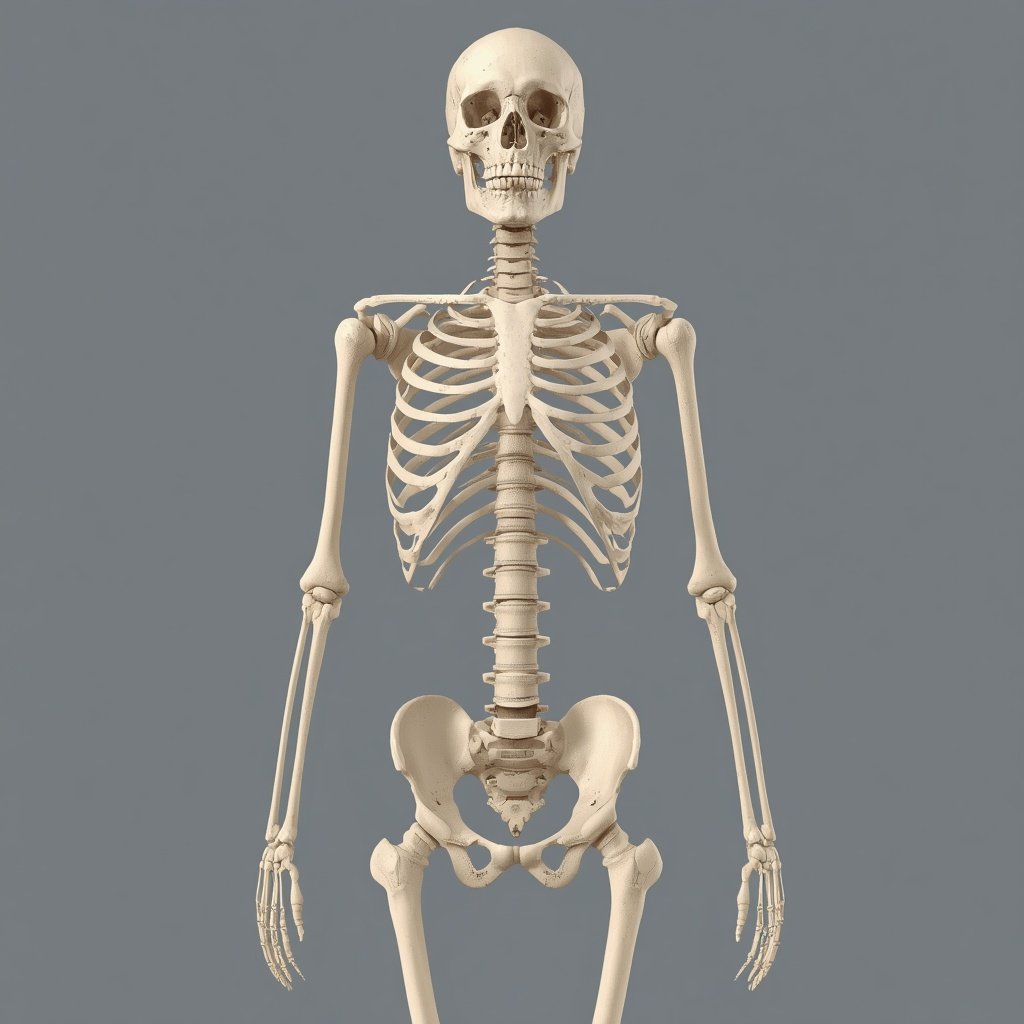
Quick Answer: How many bones are in the adult human body? The standard answer is 206 bones. Babies are actually born with closer to 270 bones, but many fuse together during childhood and adolescence, settling into the fixed adult count by around age 25. The 206 figure splits into 80 bones in the central skeleton and 126 in the limbs.
Adult Human Body Bones by Region
| Region | Bone Count |
|---|---|
| Skull (cranial + facial) | 22 |
| Middle ear bones | 6 |
| Hyoid (throat) | 1 |
| Vertebral column (spine) | 26 |
| Rib cage (ribs + sternum) | 25 |
| Axial skeleton subtotal | 80 |
| Shoulder girdle | 4 |
| Arms and hands (both sides) | 60 |
| Pelvis | 2 |
| Legs and feet (both sides) | 60 |
| Appendicular skeleton subtotal | 126 |
| Total | 206 |
The skeleton is generally split into two functional groups: the axial skeleton (skull, spine, and rib cage — the central support structure) and the appendicular skeleton (the limbs and the girdles that attach them). Roughly 60% of all bones in the body are in the arms, hands, legs, and feet combined.
Why Babies Have More Bones Than Adults
Infants are born with roughly 270 individual bones, more than adults, even though the body is much smaller. Many of these are made of soft, flexible cartilage rather than hard bone, and some skull bones are deliberately left unfused — the “soft spots,” or fontanelles, allow the skull to compress slightly during birth and leave room for rapid brain growth afterward.
Over the following two decades, many of these separate pieces fuse together. The bones of the skull knit together in infancy, sections of the spine and pelvis fuse during childhood, and the long bones in the arms and legs don’t finish fusing at their growth plates until the late teens or early twenties. By around age 25, the skeleton has settled into its final adult configuration of 206 bones.
Does Everyone Have Exactly 206 Bones?
206 is the standard figure, but it’s an average rather than a universal rule. Some people naturally have small extra bones called sesamoid bones (beyond the kneecap, which is already counted) or accessory bones in the feet and hands that don’t appear in everyone. Others may have variations in rib count — a small percentage of people are born with an extra rib, or occasionally one fewer. None of these variations are typically a health concern; they’re simply normal anatomical variation.
The Two Smallest and Largest Bones
The smallest bone in the entire body is the stapes, one of the three tiny middle ear bones, measuring about 3mm — smaller than a grain of rice. At the other extreme, the femur (thighbone) is both the longest and strongest bone in the body, capable of supporting many times an adult’s body weight. Comparing these two extremes is a useful way to appreciate just how differently bones are built depending on their job — the stapes transmits sound vibrations, while the femur bears load.
Practical Examples
A pediatrician examining a newborn’s skull is looking at bones that are still separate and mobile, which is completely normal and expected at that stage — it’s why a newborn’s head shape can temporarily look slightly molded after a vaginal delivery. By contrast, an orthopedic surgeon treating an adult’s broken femur is working with a single, fully fused, load-bearing bone that has to heal as one continuous structure, a very different situation from treating a child’s fracture near a still-growing growth plate.
Of the 206 adult bones, 54 are packed into just the hands — see our breakdown of how many bones are in the human hand for how that density compares to the rest of the body. Bone strength throughout life also depends heavily on nutrition; foods like bone broth and cottage cheese are commonly cited for their calcium and collagen content, though building strong bones is really the sum of diet, activity, and genetics over decades, not any single food.
Frequently Asked Questions
206 bones — 80 in the axial skeleton (skull, spine, rib cage) and 126 in the appendicular skeleton (limbs and girdles).
Babies are born with roughly 270 bones, many of which fuse together during childhood and adolescence, settling into the adult count of 206 by around age 25.
The stapes, one of three tiny bones in the middle ear, measuring about 3mm — smaller than a grain of rice.
The femur, or thighbone, is both the longest and strongest bone in the body.
206 is the standard average, but some people have small anatomical variations like extra sesamoid bones or an extra rib, which is generally not a health concern.
The vertebral column contains 26 bones, including the fused sections at the base of the spine (the sacrum and coccyx).
Final Answer: How Many Bones Are in the Adult Human Body
The definitive answer to how many bones are in the adult human body is 206, split between the 80-bone axial skeleton and the 126-bone appendicular skeleton. That count is lower than what we’re born with — babies start with roughly 270 bones that gradually fuse into fewer, larger structures as the skeleton matures into its adult form by the mid-twenties. Minor variation between individuals is normal and not usually a sign of anything unusual.
Pingback: How Many Bones Are in the Spine? (26 Bones) - purehealthmode
Pingback: What Is the Strongest Muscle in the Human Body? - purehealthmode