
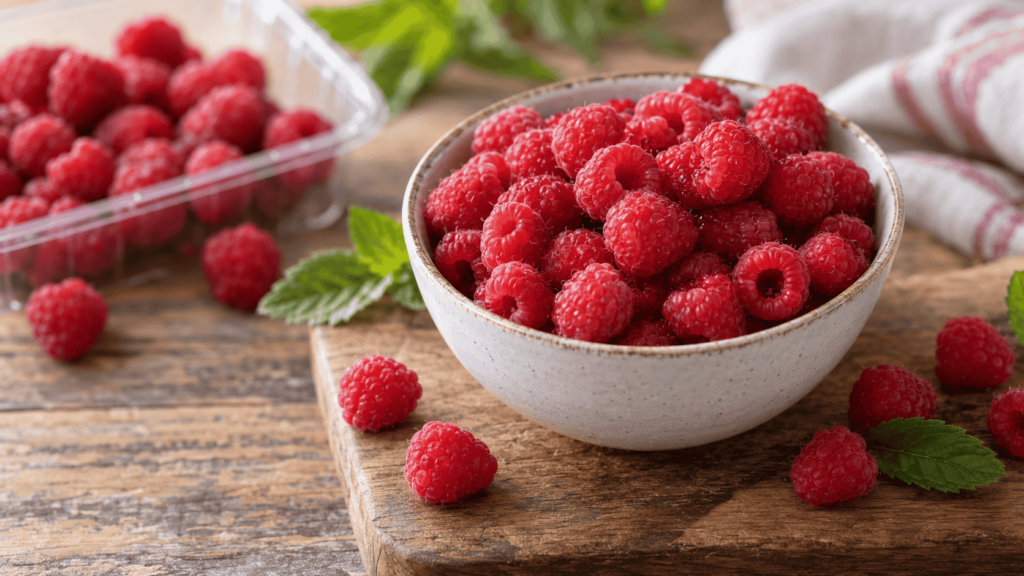
Quick Answer: 100g of fresh raspberries is roughly 50–70 individual berries, with smaller berries producing a higher count and larger berries a lower one. 100g is also about ¾ cup and roughly 52 calories. Use the calculator below to check your own berry size.
Raspberries: Grams ↔ Berry Count Calculator
Type in either box — the other updates automatically. Berry size varies naturally, so treat this as a practical estimate rather than an exact count.
Raspberry Weight Conversion: Quick Reference Table
| Raspberry Amount | Approx. Number of Raspberries |
|---|---|
| 25g | ~13–18 |
| 50g | ~25–35 |
| 75g | ~38–52 |
| 100g | ~50–70 |
| 125g | ~63–88 |
| 150g | ~75–105 |
| 200g | ~100–140 |
These are approximate counts, not exact measurements. Berry size can make a significant difference. Standard nutrition data lists 100g of raw raspberries at about 52 calories, while 1 cup weighs approximately 123g. Keep reading for cup and ounce conversions, full nutrition facts, and tips for measuring without a scale.
How Many Raspberries Are in 100g?
For everyday portion estimation, 100g of raspberries is approximately 50–70 berries, depending on their individual size. If you are using smaller raspberries, you may need closer to 60–70 berries to reach 100g. Larger cultivated raspberries can reach the same weight with considerably fewer berries.
USDA-derived serving information provides another useful reference: 10 raspberries weigh about 19g, which works out to roughly 53 raspberries per 100g.
Therefore, there isn’t one universally correct raspberry count for 100 grams. If a recipe or diet plan requires an exact weight, grams are more reliable than counting individual berries.
How Many Fresh Raspberries Is 100g?
A reasonable estimate is:
- Small raspberries: around 60–70+ berries
- Medium raspberries: around 50–60 berries
- Large raspberries: around 20–40 berries
- 100g overall estimate: roughly 50–70 raspberries
The size, variety, ripeness, and growing conditions can all affect raspberry weight. Some sources estimate an individual medium raspberry at around 3–5g, while smaller berries can weigh considerably less.
How Much Does One Raspberry Weigh?
The average raspberry weight varies considerably. A medium fresh raspberry may weigh around 3–5g, while particularly small berries can weigh less and large cultivated berries can weigh more.
This explains why counting raspberries is less precise than weighing them.
For example, if one raspberry weighs about 4g, 25 berries would provide approximately 100g. If your berries average only 2g each, you would need around 50 berries to reach the same weight.
This simple calculation can help:
100g ÷ average raspberry weight = approximate number of raspberries
Because individual raspberry weight can vary, treat this as an estimate rather than a fixed conversion.
What Does 100g of Raspberries Look Like?
So, what does 100g of raspberries look like?
Visually, 100g is a moderate portion of fresh raspberries. It may look like a small-to-medium bowlful or roughly three-quarters of a cup, although the exact volume depends on the berries and how tightly they are arranged.
As a general guide, 100g of raspberries is:
- Roughly 50–70 berries
- About 3.5 ounces
- Approximately ¾ cup
- A moderate fruit serving
- Around 52 calories
A kitchen scale is still the best option when you need exactly 100g. Visual estimates and berry counts are useful for everyday eating, but they become less reliable when raspberries differ greatly in size.
100g Raspberries in Cups
If you’re trying to convert 100g raspberries in cups, the amount is approximately ¾ cup.
Standard food-composition data lists 1 cup of raw raspberries at approximately 123g.
This means 100g is slightly less than a full cup.
Raspberry Cups-to-Grams Chart
| Raspberries | Approx. Weight |
|---|---|
| ¼ cup | ~30g |
| ½ cup | ~60g |
| ¾ cup | ~90–100g |
| 1 cup | ~120–125g |
| 1½ cups | ~180g |
| 2 cups | ~240–250g |
Remember that cups measure volume while grams measure weight. The same number of raspberries can occupy slightly different volumes depending on their size and how they are arranged.
If you’re combining raspberries with Greek yogurt for breakfast, you may also find our guide on How Many Grams in a Cup of Greek Yogurt? useful for measuring the other ingredient accurately.
100g Raspberries in Ounces
For anyone following a recipe using imperial measurements, 100g of raspberries equals approximately 3.53 ounces.
| Weight | Ounces |
|---|---|
| 50g | 1.76 oz |
| 75g | 2.65 oz |
| 100g | 3.53 oz |
| 150g | 5.29 oz |
| 200g | 7.05 oz |
These are weight ounces, not fluid ounces. Since raspberries are a solid fruit, weight ounces are the appropriate measurement for converting grams.
100g Raspberries Calories
100g raspberries contains approximately 52 calories based on standard USDA-derived nutrition data for raw raspberries.
That makes raspberries a relatively low-calorie fruit. They also contain a substantial amount of water and dietary fiber, which contributes to their overall nutritional value.
The calorie amount can vary slightly between different databases, varieties, and preparations. Fresh plain raspberries should not be treated as nutritionally identical to sweetened raspberry products, preserves, desserts, or processed foods.
For comparison, 1 cup of raw raspberries weighs about 123g and provides approximately 64 calories.
100g Raspberries Nutrition Facts
Here is an approximate nutrition profile for 100g of raw raspberries:
| Nutrient | Amount per 100g |
|---|---|
| Calories | ~52 kcal |
| Carbohydrates | ~11.9g |
| Fiber | ~6.5g |
| Sugars | ~4.4g |
| Protein | ~1.2g |
| Fat | ~0.7g |
These values are based on USDA-derived data for raw raspberries.
Fiber
Raspberries are particularly notable for their fiber content. A 100g portion provides around 6.5g of dietary fiber, making fiber one of their standout nutritional characteristics.
Carbohydrates
There are approximately 11.9g of carbohydrates in 100g raspberries. This includes naturally occurring sugars and dietary fiber.
Natural Sugar
Fresh raspberries contain about 4.4g of sugar per 100g. This sugar occurs naturally within the whole fruit rather than being added sugar. For comparison, How Many Pieces of Dried Mango Is 30g? looks at the portion and sugar content of another fruit-based snack.
Protein
Raspberries provide approximately 1.2g of protein per 100g. They contribute a small amount of protein but should not be considered a major protein source.
Fat
100g of raspberries contains only around 0.7g of fat, making them naturally low in fat.
How Many Calories Are in 1 Cup of Raspberries?
One cup of raw raspberries weighs approximately 123g and contains about 64 calories.
Compared with 100g:
- 100g raspberries: ~52 calories
- 1 cup raspberries: ~64 calories
The numbers are different because 1 cup is a volume measurement and contains more than 100g of raspberries.
If you are tracking calories precisely, measuring by weight is usually the easiest approach because it avoids uncertainty caused by different berry sizes and packing.
Is 100g of Raspberries a Serving?
Yes, 100g can be used as a practical serving of raspberries, particularly if you’re tracking food by weight. It provides around 52 calories and approximately 6.5g of fiber.
You can easily add 100g of raspberries to:
- Oatmeal
- Greek yogurt
- Smoothies
- Breakfast bowls
- Salads
- Snacks
For example, you could combine raspberries with oats and Greek yogurt for a filling breakfast. If you regularly measure oats, see our guide on How Much Is 100g of Oats? for useful cup and tablespoon conversions.
Serving sizes can vary depending on the nutrition label, recipe, and individual dietary needs, so 100g should be viewed as a convenient reference rather than a mandatory amount.
Are Raspberries Good for Weight Loss?
Raspberries can fit well into a weight-loss diet because they are relatively low in calories while providing fiber and water.
A 100g portion contains only about 52 calories but provides approximately 6.5g of fiber. This combination can make raspberries a useful addition to meals when you’re trying to create satisfying, calorie-conscious foods.
You can add them to oatmeal, plain Greek yogurt, smoothies, or a snack bowl instead of relying on higher-calorie sweet toppings.
However, raspberries do not automatically cause weight loss. Losing weight depends on your overall calorie intake, activity, eating pattern, and other factors.
If you’re planning calorie-controlled meals, our 1500 Calorie Meal Plan can provide another useful resource for building balanced meals.
Fresh vs. Frozen Raspberries: Does the Weight Change?
Fresh and frozen raspberries can both be useful, but their measured weight may differ depending on their condition.
Freezing itself does not simply remove the fruit’s mass. However, ice, frost, thawing, water loss, and draining can affect the weight you measure.
For example, a bag of frozen raspberries may contain ice crystals, while thawed berries can release some liquid. If a recipe specifically says to weigh frozen or thawed raspberries, follow that instruction.
For calorie tracking, check the package nutrition information and pay attention to whether the listed serving refers to the product frozen, thawed, or prepared.
How to Measure 100g of Raspberries Without a Scale
Don’t have a kitchen scale? You can still estimate 100g of raspberries using a few simple methods.
Method 1: Count the Berries
Count approximately 50–70 raspberries, depending on their size. Smaller berries will require more pieces, while larger berries require fewer.
Method 2: Use a Measuring Cup
Use approximately ¾ cup of raspberries as a practical estimate. Since one cup is around 123g, ¾ cup is close to 100g.
Method 3: Use the Package
If your package provides a total weight, divide the contents approximately according to the portion you need.
For example, if a package contains 200g, half of the package is approximately 100g.
For the most accurate measurement, however, a kitchen scale is the best option.
Frequently Asked Questions
Approximately 50–70 fresh raspberries, although the exact count depends heavily on berry size. Smaller berries can produce a higher count, while large raspberries require fewer pieces.
One cup of raspberries weighs about 123g. The number of individual berries can vary substantially depending on their size and arrangement.
There are approximately 52 calories in 100g of raw raspberries.
100g of raspberries is approximately ¾ cup. Since berries vary in size, this is a practical estimate rather than an exact volume conversion.
100g is approximately 3.53 ounces by weight.
A typical medium raspberry may weigh around 3–5g, but individual berries can be smaller or larger.
100g is a moderate portion. It provides roughly 52 calories and 6.5g of fiber, along with carbohydrates, natural sugars, and other nutrients.
Raspberries contain naturally occurring sugar, but they are relatively low in sugar compared with many sweet foods. A 100g portion contains about 4.4g of sugar and approximately 6.5g of fiber.
Raspberries can be a useful part of a calorie-conscious eating pattern because they provide relatively few calories along with fiber and water. However, no single food causes weight loss on its own.
Final Answer
So, how many raspberries is 100g? A practical estimate is about 50–70 fresh raspberries, although the exact number depends on their size. Smaller raspberries may require more berries, while larger ones can reach 100g with fewer pieces. 100g of raspberries is roughly ¾ cup, 3.53 ounces, and about 52 calories, with approximately 6.5g of fiber, 11.9g of carbohydrates, 1.2g of protein, and 0.7g of fat.
If you need an exact portion for a recipe, calorie tracking, or meal planning, weighing your raspberries with a kitchen scale is more accurate than counting berries or estimating by cup.