
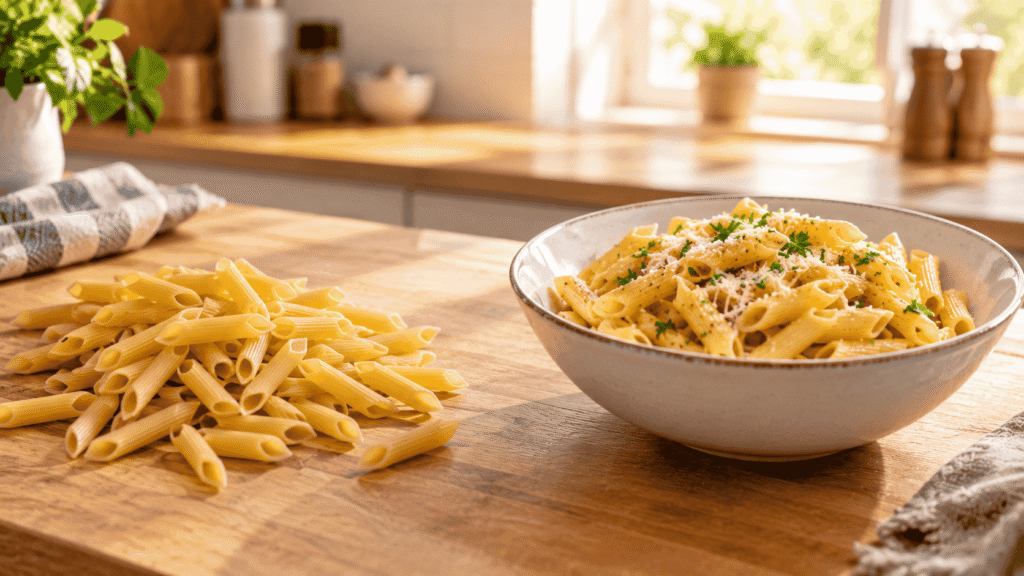
Quick Answer: 100g of dry pasta becomes about 225g cooked, since pasta roughly doubles to 2.25 times its weight as it absorbs water. That same 100g dry has about 371 calories, while the 225g it becomes once cooked has around 158 calories per 100g. Use the calculator below to convert dry and cooked weight.
Pasta: Dry ↔ Cooked Weight Calculator
Type in either box — the other updates automatically. Cooking time and how well pasta is drained also affect the final weight slightly.
Pasta Dry to Cooked Weight by Shape
| Pasta Shape | Expansion Ratio | 100g Dry Becomes |
|---|---|---|
| Spaghetti, linguine | ×2.0 | ~200g |
| Fettuccine | ×2.1 | ~210g |
| Penne, fusilli, rigatoni | ×2.25 | ~225g |
| Farfalle | ×2.3 | ~230g |
| Macaroni, orzo | ×2.5 | ~250g |
Keep reading for why shape changes the ratio, how the calories shift between dry and cooked, and how this compares with other dry-to-cooked staples like quinoa and rice.
Why Pasta Shape Changes the Cooking Ratio
Water absorption depends on how much surface area the pasta exposes and how dense the dough is. Long, solid strands like spaghetti have relatively little surface area for their mass, so they absorb less water and land closer to double their dry weight. Small, hollow, or curled shapes like macaroni and orzo expose more surface per gram, which lets them soak up more water and land closer to 2.5 times their dry weight.
Dry vs Cooked Pasta: Nutrition Facts
| Nutrient (per 100g) | Dry Pasta | Cooked Pasta |
|---|---|---|
| Calories | ~371 kcal | ~158 kcal |
| Protein | ~13g | ~5.8g |
| Carbohydrates | ~75g | ~31g |
| Fiber | ~3.2g | ~1.8g |
The calories per 100g drop by more than half after cooking, but the total calories in the pot don’t change, since the added weight is just absorbed water. This is the same reason our 100g cooked pasta nutrition figures land close to 158 calories rather than the higher dry-weight number.
Which Weight Does Your Recipe Mean?
Most packaged nutrition labels list calories for dry, uncooked pasta, which trips people up if they weigh their pasta after boiling. If a recipe or label doesn’t specify, assume dry unless it explicitly says “cooked weight.” When cooking for a specific portion, a common rule of thumb is 75 to 100g of dry pasta per person, yielding roughly 170 to 225g cooked.
How Pasta Compares to Other Dry-to-Cooked Staples
Pasta’s roughly 2 to 2.5x weight gain is noticeably less dramatic than quinoa, which nearly triples in weight, mainly because quinoa’s small seeds absorb proportionally more water than pasta’s denser dough. Rice sits closer to pasta’s range, generally landing around 2.5 to 3 times its dry weight once cooked, which is worth knowing if you’re comparing cooked rice portions against pasta ones.
Frequently Asked Questions
About 225g on average, though it ranges from around 200g for spaghetti to 250g for macaroni and orzo depending on the shape.
100g of dry pasta has about 371 calories, while 100g of cooked pasta has about 158 calories, since the cooked weight includes absorbed water.
Yes. Long, solid shapes like spaghetti roughly double in weight, while small or hollow shapes like macaroni and orzo can expand to 2.5 times their dry weight.
Usually dry weight, unless the label specifically states “cooked.” Weighing pasta after boiling and comparing it to a dry-weight label will overstate the calories per gram.
About 75 to 100g of dry pasta per person is a typical serving, yielding roughly 170 to 225g once cooked.
Final Answer: 100g Dry vs Cooked Pasta
100g of dry pasta becomes about 225g once cooked, ranging from roughly 200g for spaghetti to 250g for macaroni, as it absorbs water during boiling. The calories stay the same in total, just spread across a heavier cooked portion. Checking whether a recipe or label means dry or cooked weight before you measure will save you from over- or under-estimating a serving.