
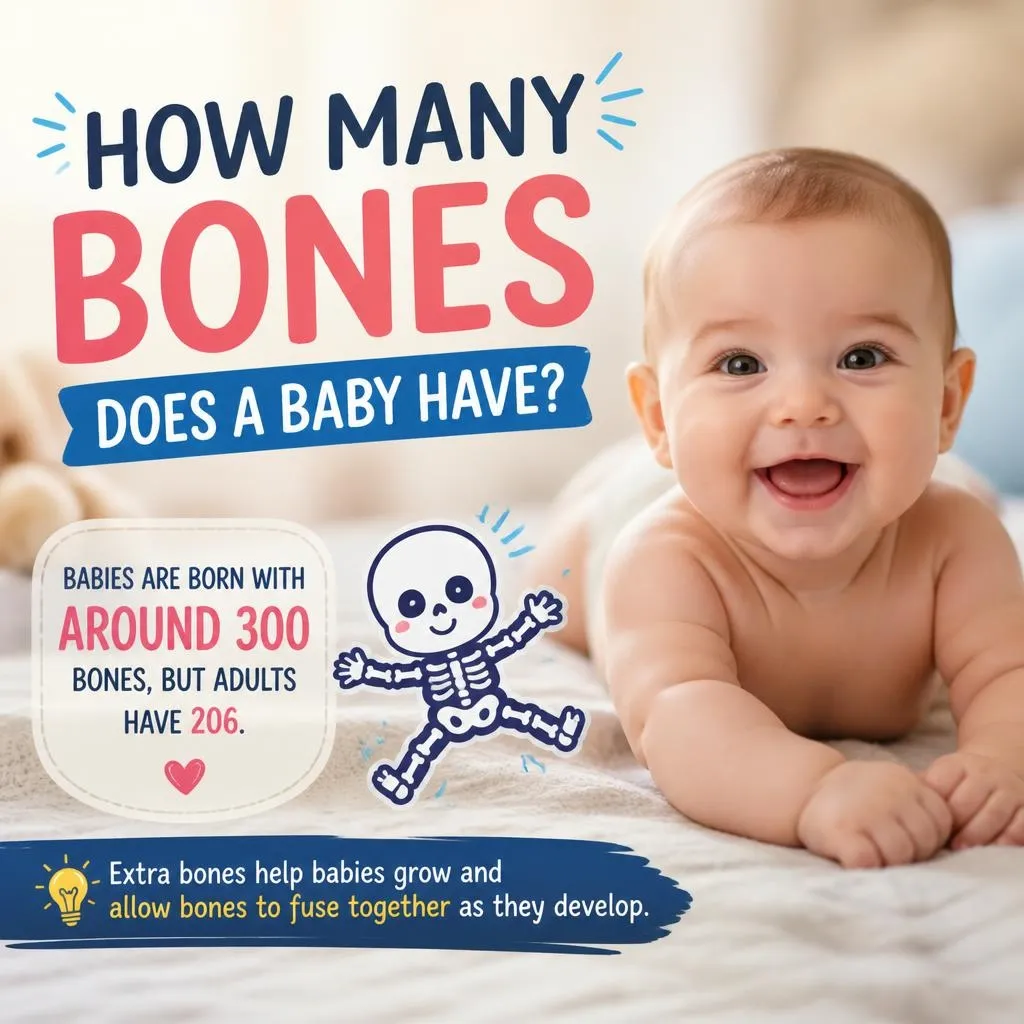
Quick Answer: How many bones does a baby have? A newborn has about 270 to 300 bones, many of them still partly made of soft cartilage. An adult has 206. The difference isn’t lost bones: as a child grows, many small bones gradually fuse together, mostly in the skull, spine, and pelvis, a process that finishes in the early to mid-20s.
How Many Bones Does a Baby Have vs an Adult?
| Area | In a Newborn | In an Adult |
|---|---|---|
| Total bones | ~270–300 | 206 |
| Skull | Separate plates with soft spots (fontanelles) | Fused cranial bones |
| Sacrum (base of spine) | 5 separate vertebrae | 1 fused bone |
| Coccyx (tailbone) | 3–5 separate segments | 1 fused bone (sometimes 2) |
| Each hip bone | 3 bones (ilium, ischium, pubis) | 1 fused bone |
| Long bones | Shaft and ends separated by growth plates | Growth plates closed |
Keep reading for which bones fuse and when, and the bone conditions that can affect babies and children.
How Many Bones Are in a Newborn Baby?
Counts for newborns vary from about 270 to 300 because many “bones” are still separate pieces, or ossification centers, joined by cartilage. This flexibility is useful: the soft skull plates can overlap slightly during birth, and the cartilage lets bones grow quickly through infancy and childhood. Over time, cartilage is replaced by hard bone in a process called ossification.
How Many Bones Fuse Together After Birth?
Roughly 70 to 90 separate pieces fuse together between birth and adulthood. The main ones are:
- Skull: the soft spots close first. The back one by about 2 to 3 months and the front one usually by 12 to 24 months. The full skull structure is covered in how many bones are in the human skull.
- Hip bones: the ilium, ischium, and pubis fuse into each hip bone, mostly during the teenage years, as explained in how many bones are in the human pelvis.
- Sacrum and coccyx: five sacral vertebrae fuse into one bone by the mid-20s, and the tailbone segments fuse too.
- Growth plates: the ends of long bones join their shafts when growth stops, usually in the late teens.
Bone Conditions in Babies and Children
- Craniosynostosis: when skull plates fuse too early, causing an unusual head shape. It’s often treated with surgery.
- Developmental dysplasia of the hip (DDH): a loose or poorly formed hip socket, checked at newborn exams.
- Rickets: soft, weak bones from a lack of vitamin D or calcium.
- Osteogenesis imperfecta: a genetic condition, sometimes called brittle bone disease, that causes bones to break easily.
When to see a doctor: talk to your pediatrician about a misshapen head, a soft spot that looks sunken or bulging, uneven leg creases or hip clicking, bowed legs that worsen after age 2, or frequent fractures. For a full map of the adult skeleton, see how many bones are in the adult human body.
Frequently Asked Questions
About 270 to 300 bones, many still partly made of cartilage. They fuse into 206 bones by adulthood.
Many of a baby’s bones are separate pieces joined by cartilage, which later fuse together as the child grows.
Mainly the skull plates, the three bones of each hip, the five sacral vertebrae, the tailbone segments, and the growth plates of long bones.
The back soft spot closes by about 2 to 3 months, and the front soft spot usually closes between 12 and 24 months.
Final Answer: How Many Bones Does a Baby Have
A baby has about 270 to 300 bones, which gradually fuse into the 206 bones of an adult skeleton by the early to mid-20s. Regular pediatric checkups track healthy bone and skull development, so mention any concerns about head shape, hips, or bowed legs at those visits.