
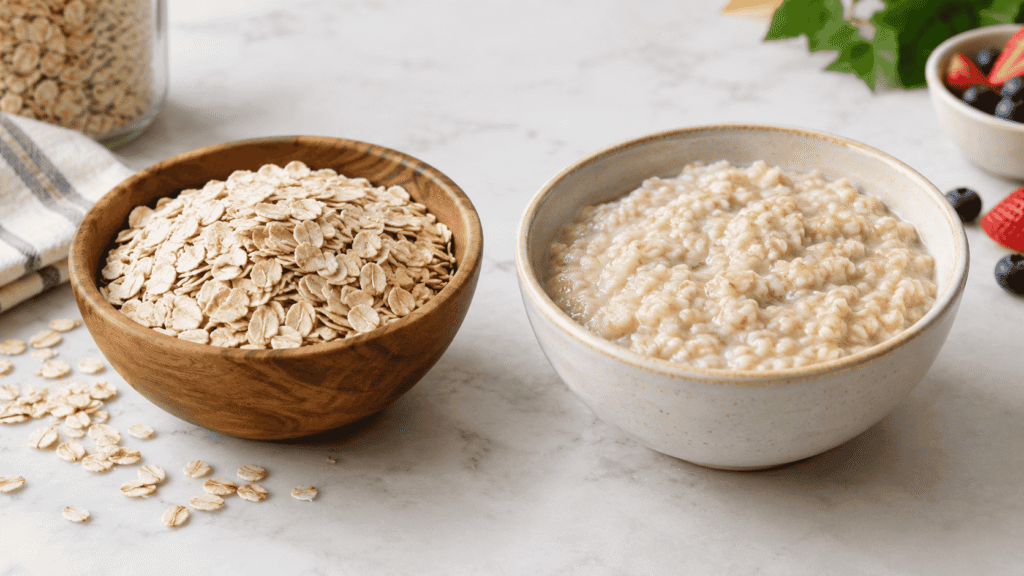
Quick Answer: Oats dry vs cooked weight differs by roughly 2 to 3.5 times — dry oats absorb water as they simmer, so they gain weight rather than lose it, the opposite of what happens with meat or fish. 100g of dry oats becomes about 250–300g of cooked oatmeal, and 40g dry (a common single serving) becomes roughly 100–120g cooked. Use the calculator below for your oat type.
Oats Dry ↔ Cooked Weight Calculator
Type in either box — the other updates automatically. The ratio depends heavily on how much liquid you use and your preferred consistency.
Oats Dry vs Cooked Weight by Type
| Oat Type | Approx. Ratio | 40g Dry Becomes |
|---|---|---|
| Quick oats | ~2x | ~80g |
| Rolled oats | ~2.75x | ~110g |
| Steel-cut oats | ~3.5x | ~140g |
Notice this runs the opposite direction from meat or fish — oats gain weight when cooked instead of losing it, since they’re absorbing liquid rather than releasing it. It’s the same underlying idea as chicken breast losing water when cooked, just flowing in the reverse direction.
Why Oat Type Changes the Dry-to-Cooked Ratio
Steel-cut oats are the least processed form — whole oat groats chopped into pieces rather than steamed and flattened. That denser starting structure means they need more liquid and more cooking time to soften, which is why they end up absorbing proportionally more water than rolled or quick oats by the time they’re done, landing closer to a 3.5x weight gain rather than 2.5x.
Quick oats sit at the other end. They’re pre-steamed and cut into small pieces specifically so they cook fast with less added liquid, so they typically finish at a lower ratio — closer to doubling in weight rather than tripling.
How Liquid Ratio Changes the Final Weight
The multiplier isn’t fixed — it depends heavily on how much liquid you cook with and how thick you like your oatmeal. A standard 1:2 oats-to-water ratio (by volume) produces the “average” 2.5-2.75x weight gain used in the table above. If you prefer thinner, porridge-style oatmeal and use closer to a 1:3 ratio, the cooked weight climbs higher — sometimes past 3.5x even for rolled oats. Thick, stiff oatmeal made with less liquid will land on the lower end regardless of oat type.
This is different from meat and fish shrinkage, which is driven almost entirely by the food itself and barely affected by how you cook it. Oat weight gain is driven mostly by a choice you make — how much water goes in the pot — which makes it more variable, not less.
Cooking With Milk vs. Water
Cooking oats in milk instead of water produces a similar weight-gain ratio, since milk is still mostly water by volume, but it adds extra calories and protein from the milk solids that get absorbed along with the liquid. If you’re tracking calories, the “40g dry oats = 110g cooked” figure only accounts for the oats — milk, sweetener, or fruit added afterward changes both the weight and the nutrition on top of that base conversion.
Practical Examples
A single-serving packet of instant oatmeal typically contains about 28-35g of dry oats, which becomes roughly 70–95g cooked once water is added — noticeably less than the 40g serving used as the reference elsewhere on this site’s 100g oats measurement guide, so check the specific packet size rather than assuming a standard serving.
A family-size pot of steel-cut oats made with 200g dry oats yields close to 700g of cooked oatmeal — enough for roughly four generous bowls. And a batch of overnight oats made with 50g of rolled oats and left to soak overnight typically finishes closer to the higher end of the ratio, since the oats have far more time to absorb liquid than they would during a quick stovetop cook — often landing around 150g rather than the standard 135-140g you’d get from cooking the same 50g on the stove.
Once you understand oats dry vs cooked weight as a ratio rather than a fixed number, it’s easy to scale any recipe up or down — double the dry oats and you double the cooked result, regardless of which oat type or liquid ratio you’re using. If you’re comparing this to how rice changes weight when cooked, the underlying mechanism is the same — both foods absorb water as they cook — though rice typically lands around a 3x weight increase, somewhat higher than the average oat ratio.
Frequently Asked Questions
Cooked oats typically weigh about 2 to 3.5 times their dry weight, depending on the oat type and how much liquid is used.
Yes. Steel-cut oats typically gain around 3.5x their dry weight, compared to about 2.75x for rolled oats and 2x for quick oats, since they absorb more liquid during their longer cook time.
40g of dry rolled oats typically weighs about 100–120g once cooked, depending on how much liquid is used.
Not significantly, since milk is still mostly water by volume. It does add extra calories and protein from the absorbed milk solids on top of the oats themselves.
Measure dry, before cooking. Nutrition labels and most tracking apps list oat calories based on dry weight, so weighing after cooking will understate the calories per gram.
Overnight oats have more time to absorb liquid since they soak for hours rather than cooking briefly on the stove, which typically pushes them toward the higher end of the weight-gain ratio.
Final Answer: Oats Dry vs Cooked Weight
The bottom line on oats dry vs cooked weight is that oats gain, rather than lose, weight during cooking — typically 2 to 3.5 times their dry weight, depending on the oat type and how much liquid you use. Quick oats sit at the low end near 2x, rolled oats average around 2.75x, and steel-cut oats climb toward 3.5x thanks to their longer cook time and heavier water absorption. Since the ratio shifts with your preferred consistency, use dry weight as your baseline for nutrition tracking, and treat the cooked figure as a flexible estimate rather than a fixed rule.