
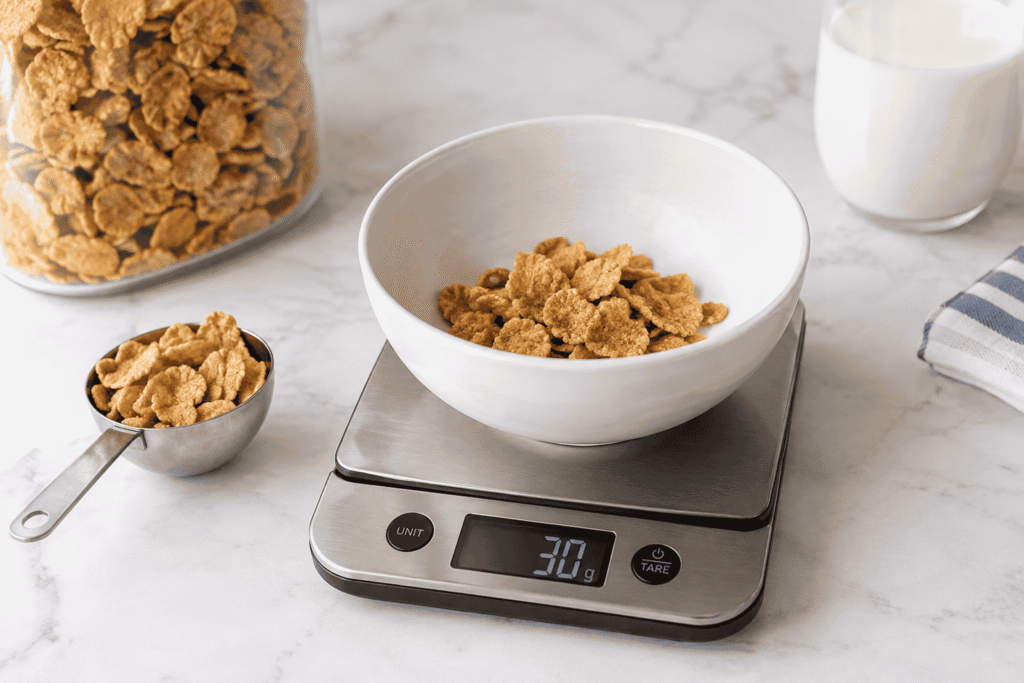
Quick Answer: 30g of light, flaked cereal (like corn flakes or bran flakes) fills about ¾ to 1 cup and barely covers the bottom of a standard cereal bowl. Denser cereals like granola or muesli take up much less visual space for the same 30g, while airy puffed cereals can look like they fill an entire bowl at the same weight. The only way to know for certain is to weigh it, since eyeballing a “bowl’s worth” is one of the easiest ways to accidentally double a serving.
Thirty grams is the standard single-serving size printed on most cereal boxes, but very few people actually measure it — most just pour cereal into a bowl until it “looks right.” The problem is that 30g looks completely different depending on the cereal.
Why 30g Doesn’t Look the Same for Every Cereal
Cereal isn’t a uniform product. A gram of it can occupy very different amounts of space depending on how it’s made:
- Density – Flaked cereals are light and full of air pockets, so they take up more volume per gram than dense, compact cereals like granola clusters.
- Shape – Puffed cereals (like puffed rice or puffed wheat) trap the most air and look the biggest for their weight.
- Added ingredients – Granola with nuts, seeds, or dried fruit is heavier by volume, so 30g of it looks noticeably smaller in a bowl than 30g of a light flake cereal.
- Piece size – Larger flakes settle with more gaps between them, while small flakes or O-shaped cereals pack more tightly.
This is the same reason a food scale gives more consistent portion results than a measuring cup — a detail also worth knowing if you’re comparing this to other kitchen staples like how much 100g of oats measures out to.
30g of Cereal by Type: What to Expect
| Cereal Type | Approximate Volume at 30g | Visual Reference |
|---|---|---|
| Corn flakes / bran flakes | ¾–1 cup | Covers the bottom of a standard bowl, not stacked |
| Wheat biscuits / shredded wheat | 1–2 biscuits | About 1–2 individual pieces |
| Granola (dense, clustered) | ¼–⅓ cup | A small handful, doesn’t spread far |
| Puffed rice / puffed wheat | 1–1½ cups | Looks like a full bowl, very light |
| Muesli (mixed oats, fruit, nuts) | ⅓–½ cup | A modest scoop, denser than flakes |
| O-shaped cereal (toasted oat rings) | ¾–1 cup | Fills most of a small bowl |
These are practical estimates, not exact universal numbers — brands vary in flake thickness and shape, so the same cereal from two different companies can look slightly different at 30g. When precision matters, a kitchen scale will always be more reliable than volume alone.
The Bowl Test: What 30g Actually Looks Like
If you don’t have a scale handy, here’s a useful visual gut-check:
- In a standard-sized cereal bowl (roughly 6 inches across), 30g of light flake cereal will cover the base in a single, mostly flat layer — it will not mound up or fill the bowl.
- If your cereal is piled high and rounded on top, you’re very likely looking at 45–60g or more, especially with lighter cereals.
- Puffed cereals are the exception — because they’re so light, 30g can genuinely look like a full bowl even though the actual weight is small. This is a common reason people underestimate calories with airy cereals; the bowl “looks empty” compared to a bowl of granola at the same weight.
Measuring Cup vs. Kitchen Scale
A dry measuring cup can give you a reasonable estimate, but it’s not as accurate as weighing:
- Measuring cup: Fast and convenient, but flakes settle differently depending on how they’re poured (loosely spooned vs. lightly shaken), which can shift the actual gram weight by several grams either way.
- Kitchen scale: The most accurate method, especially for cereals with mixed pieces (like muesli with nuts and dried fruit), where volume measurements can vary a lot from scoop to scoop.
If you’re weighing out breakfast portions regularly, it’s worth applying the same approach to other foods you might be combining with cereal — for example, checking how many walnuts make up a 30g portion if you’re adding nuts, or how many pieces of dried mango equal 30g if you’re mixing in dried fruit.
What About the Milk?
Most nutrition labels calculate calories and macros based on cereal alone, or cereal with a specific amount of milk (often ½ cup). Milk changes the visual portion significantly — a bowl that looks “small” with just 30g of dry cereal will look much fuller once milk is added, which is part of why bowls often end up overfilled with cereal in the first place: people pour cereal to the level they want it to look like after milk, not before. If you like the idea of a milk-based breakfast you can prep ahead of time, how to make overnight oats is a simple, measurable alternative that swaps the guesswork of a morning pour for portions you set the night before.
Common Mistakes When Estimating 30g
- Judging by bowl height instead of weight. Bowl shape varies a lot, so “half full” in a wide, shallow bowl is a very different amount than “half full” in a deep, narrow one.
- Assuming all cereals behave the same. A cup of puffed cereal and a cup of granola can differ by 15–20g or more at the same volume.
- Pouring straight from the box. This tends to overestimate portions because gravity naturally settles cereal into a denser pile than a loosely measured cup.
- Ignoring the serving size on the label. Many boxes list servings based on ¾ cup or 1 cup, not a full bowl — checking the label alongside a scale, at least once, helps calibrate your eye for future pours.
Frequently Asked Questions
It depends on the cereal. Light, puffed cereals can look like a full bowl at 30g, while dense granola will look like a modest handful in the same bowl.
Use a dry measuring cup as a rough guide — about ¾ to 1 cup for most flake cereals — but expect some variation since pouring technique affects volume.
Yes, 30g is the standard single-serving size used on most cereal nutrition labels, though some brands list servings anywhere from 27g to 45g depending on the product.
Packaging images often show cereal with milk added, and sometimes in bowls smaller than they appear in photos, which can make the dry serving look more generous than it is in reality.
Yes. Mix-ins like nuts and dried fruit are denser than flaked cereal, so a 30g mixed serving will look smaller in volume than 30g of flakes alone.
Final Answer: What Does 30g of Cereal Look Like?
30g of cereal looks different depending on the type — light flakes fill about ¾ to 1 cup, dense granola fits into a small ¼ to ⅓ cup handful, and puffed cereal can look like a full bowl despite being very light.
- Flakes: ¾–1 cup, a flat layer covering the bowl base
- Granola: ¼–⅓ cup, a small handful
- Puffed cereal: 1–1½ cups, can look like a full bowl
The biggest thing to remember is that volume is not a reliable stand-in for weight across different cereals. Weighing a serving once with a kitchen scale gives you a real visual reference for your specific cereal and bowl, so future mornings only need a quick glance rather than a full measurement.