
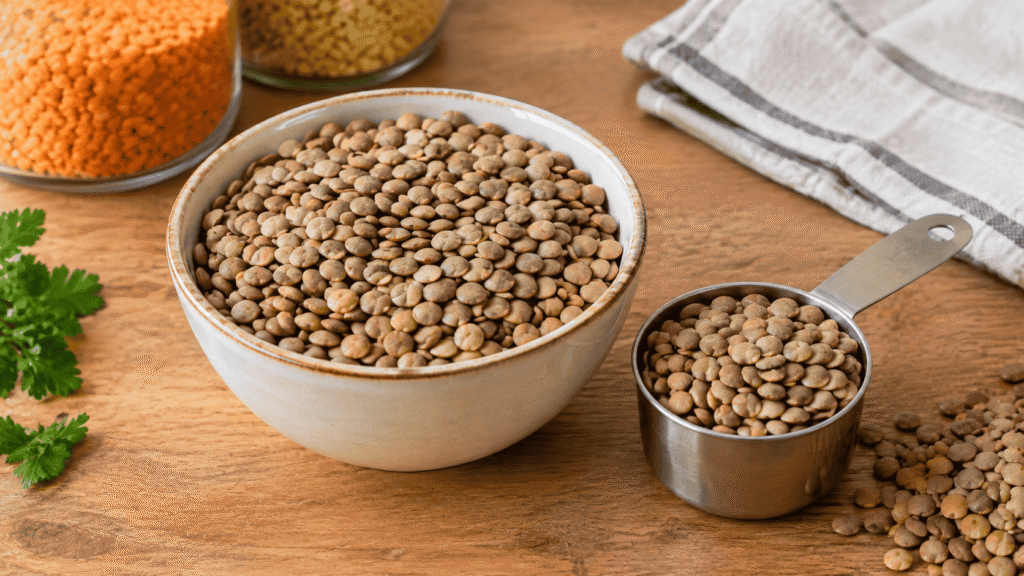
If you are wondering how much 100g of lentils is, the answer depends on whether the lentils are dry or cooked. Cooking adds water, so the same 100g measurement looks very different before and after cooking.
As a quick guide, 100g of dry lentils is approximately 1⅔ cups, while 100g of cooked lentils is about 0.57 cup, or a little more than ½ cup. These are approximate measurements because lentil variety, moisture, cooking method, and how tightly the lentils are packed can affect volume.
In this guide, you will find measurements for 100g of dry and cooked lentils, including cups, tablespoons, ounces, calories, protein, fiber, serving sizes, and simple ways to measure lentils without a kitchen scale.
How Much Is 100g of Lentils?
The simplest answer is:
- 100g dry lentils: approximately 1⅔ cups
- 100g cooked lentils: approximately 0.57 cup, or a little more than ½ cup
- 100g lentils: approximately 3.53 ounces by weight
The difference happens because dry lentils absorb water while cooking. USDA portion information uses approximately 60g for 1 cup of uncooked lentils and 175g for 1 cup of cooked lentils, which gives these approximate conversions.
| Measurement | Dry Lentils | Cooked Lentils |
|---|---|---|
| 100g | 100g | 100g |
| Approx. cups | ~1⅔ cups | ~0.57 cup |
| Water content | Low | Much higher |
| Cooking effect | Absorbs water | Already hydrated |
These figures should be treated as practical estimates rather than exact measurements.
100g Dry vs. 100g Cooked Lentils
100g of dry lentils does not equal 100g of cooked lentils in volume or nutritional concentration. Dry lentils contain much less water, while cooked lentils contain considerably more because they absorb water during cooking.
That means you should not substitute a dry measurement for a cooked measurement when tracking calories or following a recipe.
How Much Is 100g of Dry Lentils?
100g of dry lentils is approximately 1⅔ cups, based on a cup-equivalent weight of about 60g.
In tablespoons, this works out to roughly 27 tablespoons. Since 1 ounce equals about 28.35g, 100g of dry lentils is also approximately 3.53 ounces.
What does 100g dry lentils look like? Imagine filling a measuring cup with dry lentils to around the 1⅔-cup mark. The lentils will appear small, hard, and separate, with little empty space between individual lentils.
The exact volume can vary slightly between brown, green, red, and black lentils because their size, shape, and density are not identical.
What Does 100g of Dry Lentils Look Like?
A bowl containing 100g of dry lentils will look substantially larger than a bowl containing 100g of cooked lentils. Dry lentils are small and compact, so approximately 1⅔ cups can fit into a relatively modest bowl.
If you are creating a visual guide for this article, a natural image showing 100g of dry lentils beside a measuring cup can make this measurement easier for readers to understand.
How Much Is 100g of Cooked Lentils?
100g of cooked lentils is approximately 0.57 cup, which is a little more than ½ cup.
Cooking causes lentils to absorb water. USDA cooking-yield information puts the cooked-to-uncooked weight increase at roughly 2.7 times, although the exact result can vary with cooking time and the amount of water used.
This is why 100g of cooked lentils occupies less volume than 100g of dry lentils. The cooked lentils are heavier because much of their weight comes from absorbed water.
For calorie tracking, always check whether your measurement refers to dry or cooked lentils. Using the nutritional value for dry lentils when you actually weighed cooked lentils can significantly overestimate your calorie intake. People also commonly enjoy lentils with rice, so if you’re measuring your meal portions, you may also find our guide to How Many Grams in 1 Cup Cooked Rice? helpful.
How Many Cups Is 100g of Cooked Lentils?
100g of cooked lentils is approximately 0.57 cup, or slightly more than ½ cup.
Because cooked lentils can retain different amounts of water, the exact volume can vary. A kitchen scale is therefore more reliable when a recipe or nutrition plan calls for exactly 100g.
100g of Lentils in Cups
The cup measurement for 100g depends mainly on whether the lentils are dry or cooked.
100g Dry Lentils in Cups
100g of dry lentils = approximately 1⅔ cups.
This estimate is based on approximately 60g of uncooked lentils per cup.
100g Cooked Lentils in Cups
100g of cooked lentils = approximately 0.57 cup.
That is a little more than ½ cup.
Why Does the Cup Measurement Change?
Lentils absorb water during cooking. Their weight and volume therefore change considerably.
For example, 100g of dry lentils can produce substantially more than 100g of cooked lentils after absorbing water. The important point is that grams measure weight, while cups measure volume. Cooking changes the relationship between the two.
100g of Lentils in Ounces
100g of lentils is approximately 3.53 ounces by weight.
This conversion is based purely on weight, so it applies whether the lentils are dry or cooked.
However, 100g of dry lentils and 100g of cooked lentils will occupy different amounts of space because cooked lentils contain more water.
If a recipe uses ounces instead of grams, you can use 3.53 oz as the equivalent of 100g.
100g of Lentils in Tablespoons
Tablespoon measurements are less precise than weighing because individual lentils can settle differently in a spoon.
As a practical estimate:
- 100g dry lentils: about 27 tablespoons
- 100g cooked lentils: about 9 tablespoons
These are approximate conversions based on the cup measurements above.
For everyday cooking, tablespoons can be useful when you do not have measuring cups. However, if you are tracking calories, protein, or carbohydrates, a kitchen scale is the better option because it measures actual weight rather than estimating volume.
How Many Calories Are in 100g of Lentils?
The calories in 100g of lentils depend on whether you mean dry or cooked lentils.
According to USDA FoodData Central data, 100g of dry lentils contains about 352 calories, while 100g of cooked lentils contains about 116 calories.
The large difference does not mean cooking removes most of the calories. Instead, cooking adds water, increasing the weight of the food without adding significant calories. As a result, the calories become less concentrated per 100g.
For this reason, always identify whether a nutrition value refers to dry lentils or cooked lentils before using it for calorie tracking. USDA FoodData Central provides food composition data on a 100g basis and also provides portion information for many foods.
100g Lentils Nutrition
The following table gives approximate nutrition values for 100g of dry and cooked lentils.
| Nutrient | 100g Dry Lentils | 100g Cooked Lentils |
|---|---|---|
| Calories | ~352 kcal | ~116 kcal |
| Protein | ~24.6g | ~9.0g |
| Carbohydrates | ~63.4g | ~20.1g |
| Fiber | ~10.7g | ~7.9g |
| Fat | ~1.1g | ~0.4g |
Values can vary depending on the specific lentil product and database entry. USDA FoodData Central is a comprehensive food-composition database, and its nutrient information is generally reported on a 100g edible-portion basis.
Protein
Lentils are a useful plant-based source of protein. 100g of dry lentils provides roughly 24.6g of protein, while 100g of cooked lentils provides about 9g.
The lower number per 100g after cooking is largely due to the additional water. If you’re comparing lentils with other protein-rich foods, you may also want to see How Many Eggs Equal 30g Protein?.
Fiber
Lentils are also rich in dietary fiber. About 100g of cooked lentils provides approximately 7.9g of fiber, while the dry measurement contains around 10.7g.
Carbohydrates
Most of the calories in lentils come from carbohydrates. Dry lentils contain around 63g of carbohydrates per 100g, compared with about 20g in cooked lentils.
Fat
Lentils are naturally low in fat. Cooked lentils contain only around 0.4g of fat per 100g, while dry lentils contain about 1.1g.
What Is a Serving Size of Lentils?
A lentil serving size depends on how the lentils are measured and what you are preparing.
For many meals, cooked lentils are measured by the cup, while recipes may list dry lentils by grams, cups, or weight. USDA/MyPlate also includes lentils within the beans, peas, and lentils group and uses cup-equivalent serving guidance.
When tracking nutrition, it is important to know whether the serving size is referring to dry lentils or cooked lentils. They have very different weights and calorie concentrations.
If you are preparing lentils for a meal, measuring the cooked portion can be convenient. If you are following a precise nutrition plan, weighing the food is generally more accurate.
How to Measure 100g of Lentils Without a Scale
You can estimate 100g of lentils without a kitchen scale, although the result will not be as precise.
Use Measuring Cups
For dry lentils, use approximately 1⅔ cups.
For cooked lentils, use approximately 0.57 cup, or a little more than ½ cup.
Use Tablespoons
You can estimate 100g using approximately 27 tablespoons of dry lentils or about 9 tablespoons of cooked lentils.
Because spoon measurements can vary depending on how the lentils are packed, this should only be considered an estimate.
Use a Kitchen Scale
A kitchen scale is the most accurate option. Place your bowl on the scale, tare it to zero, and add lentils until the display reaches 100g.
This is especially useful if you are counting calories or following a recipe that requires precise quantities.
50g, 100g, 150g and 200g Lentils Conversion Chart
The following chart provides approximate conversions.
| Lentils | Dry Approx. Cups | Cooked Approx. Cups |
|---|---|---|
| 50g | ~0.83 cup | ~0.29 cup |
| 100g | ~1.67 cups | ~0.57 cup |
| 150g | ~2.5 cups | ~0.86 cup |
| 200g | ~3.33 cups | ~1.14 cups |
These figures are estimates based on the approximate cup weights above. Actual measurements can vary depending on the type of lentils and how they are measured.
Does the Type of Lentil Change the Measurement?
Yes. Different varieties can have slightly different measurements by volume.
Green lentils tend to remain firm after cooking, while brown lentils are commonly softer. Red lentils are smaller and usually cook faster, often breaking down more easily. Black lentils are also relatively small and tend to retain their shape when cooked.
Because lentils differ in size, shape, density, and cooking behavior, 100g may not occupy exactly the same volume across every variety.
For precise measurements, weighing the lentils is preferable to relying entirely on cups or tablespoons.
Frequently Asked Questions
100g of dry lentils is approximately 1⅔ cups. For cooked lentils, 100g is approximately 0.57 cup.
100g of cooked lentils is approximately 0.57 cup, or a little more than ½ cup.
100g of dry lentils is approximately 1⅔ cups, based on about 60g per cup.
Approximately 352 calories are in 100g of dry lentils, while 100g of cooked lentils contains about 116 calories.
100g of dry lentils contains about 24.6g of protein, while 100g of cooked lentils contains about 9g.
100g of dry lentils is roughly 1⅔ cups, while 100g cooked is roughly 0.57 cup. The appearance will vary by lentil variety.
Yes. You can estimate it with measuring cups or tablespoons, but a kitchen scale provides the most accurate measurement.
Final Answer: How Much Is 100g of Lentils?
So, how much is 100g of lentils? It depends on whether they are dry or cooked.
- 100g dry lentils: approximately 1⅔ cups
- 100g cooked lentils: approximately 0.57 cup
- 100g lentils: approximately 3.53 ounces
- 100g dry lentils: about 27 tablespoons
- 100g cooked lentils: about 9 tablespoons
The biggest thing to remember is that dry and cooked lentils should not be measured interchangeably. Cooking adds water, changing the weight, volume, and calories per 100g. For the most accurate measurement, especially when tracking nutrition, use a kitchen scale.