
Quick Answer:
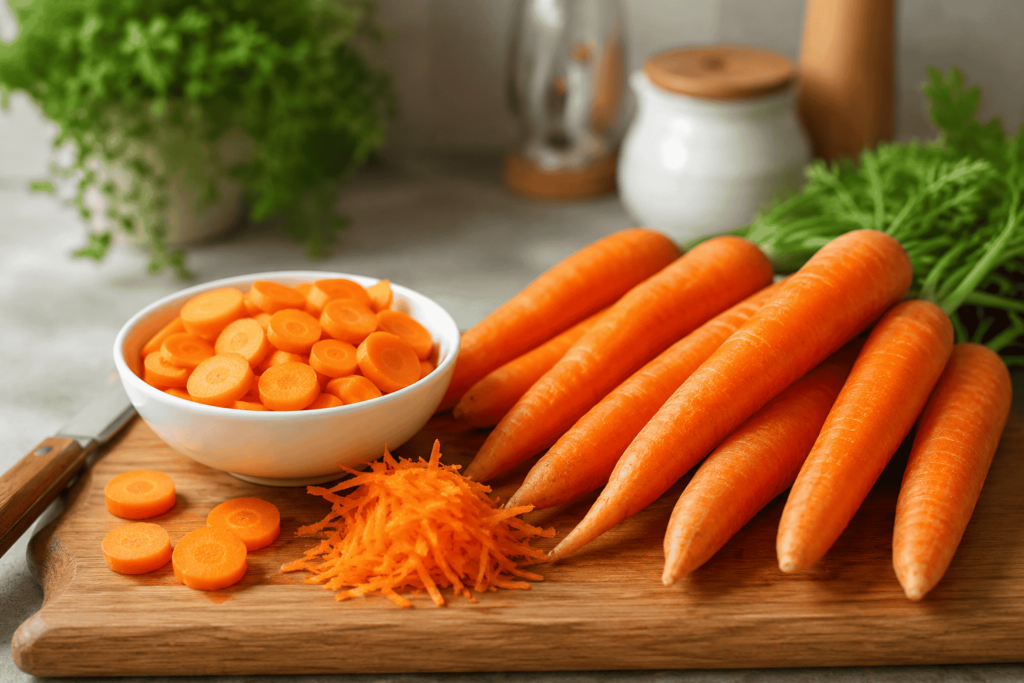
100g of raw carrots is roughly ¾ cup when chopped or sliced and about 3–4 smaller or medium carrots. It contains approximately 40 calories and is particularly rich in beta-carotene, a provitamin A carotenoid that the body can convert into vitamin A. The exact amount varies with carrot size and preparation. Use the calculator below to check your own prep style.
Carrots: Grams ↔ Cups/Count Calculator
Type in either box — the other updates automatically. Carrot size and cut style vary, so treat this as a practical estimate.
The amount of carrots that equals 100g depends on their size and how you prepare them. Whole carrots take up less predictable space than chopped or shredded carrots, so volume measurements are only estimates.
100g of Carrots in Cups, Ounces & Other Measurements
| Measurement | Approximately 100g of Carrots |
|---|---|
| Grams | 100g |
| Ounces | ~3.5 oz |
| Cups, chopped | ~¾ cup |
| Cups, shredded | ~1 cup |
| Medium carrots | ~3–4 |
| Baby carrots | Varies by size |
These measurements are approximate because whole, sliced, chopped, and shredded carrots pack differently. For recipes where accuracy matters, measuring by weight is preferable. Keep reading for a full breakdown by preparation style, calories, nutrition facts, and beta-carotene content.
100g of Whole Carrots
100g of whole carrots is approximately 3–4 smaller or medium carrots. Large carrots may weigh considerably more, so you may need fewer than three to reach 100g.
100g of Chopped Carrots
Once chopped, 100g of carrots is roughly ¾ cup. The pieces can pack differently depending on how finely the carrots are cut, so this should be treated as an approximate measurement.
100g of Sliced Carrots
Sliced carrots also measure around ¾ cup per 100g, although thinner or thicker slices can slightly change the volume.
100g of Shredded Carrots
Because shredded carrots contain more air between the pieces, 100g can occupy about 1 cup. The exact volume depends on how finely the carrots are shredded and whether they are loosely or tightly packed.
100g of Baby Carrots
The number of baby carrots in 100g varies considerably by size. Smaller baby carrots may require more pieces, while larger ones require fewer. Weighing them is more reliable than counting individual pieces.
What Does 100g of Carrots Look Like?
If you don’t have a kitchen scale, visual estimates can help you understand the approximate portion size.
How Many Medium Carrots Are 100g?
A 100g portion is roughly equivalent to 3–4 smaller or medium carrots. Since carrots naturally differ in length and thickness, the actual number can vary.
How Many Baby Carrots Are 100g?
There isn’t one fixed number because baby carrots aren’t all the same size. A handful may be close to 100g, but counting them is less accurate than weighing them.
How Much Chopped Carrot Is 100g?
100g of chopped carrots is approximately ¾ cup. This makes it relatively easy to estimate when preparing salads, soups, stir-fries, or other recipes.
How Big Is a 100g Serving of Carrots?
A 100g serving is a moderate portion of carrots, roughly filling three-quarters of a cup when chopped. It provides relatively few calories while contributing fiber and several micronutrients.
100g Carrots Nutrition Facts
Carrots are relatively low in calories while providing carbohydrates, fiber, and important micronutrients. The following values are approximate for raw carrots.
| Nutrient | Amount per 100g |
|---|---|
| Calories | ~41 kcal |
| Carbohydrates | ~10g |
| Protein | ~1g |
| Fat | ~0.2g |
| Fiber | ~3g |
| Sugar | ~5g |
| Potassium | ~320mg |
| Vitamin C | ~6mg |
| Beta-carotene | Varies |
Exact nutritional values can differ somewhat depending on carrot variety, growing conditions, and preparation.
How Many Calories Are in 100g of Carrots?
Carrots are a relatively low-calorie food, which makes them easy to include in meals and snacks.
Calories in 100g of Raw Carrots
100g of raw carrots contains approximately 41 calories. Most of these calories come from carbohydrates, including naturally occurring sugars.
Calories in 100g of Cooked Carrots
The calorie value of cooked carrots can vary depending on how they are prepared. Cooking without added oil or other ingredients generally does not dramatically change the total calories in the original carrots.
Calories in 100g of Boiled Carrots
Boiled carrots can have a different calorie value per 100g because they absorb water during cooking. This changes their weight and therefore affects the calories measured per 100g.
Do Cooked Carrots Have More Calories?
Not necessarily. The important distinction is between total calories and calories per 100g. Cooking can change the water content and weight of carrots, so calories per 100g may change even when no calories have been added.
Adding butter, oil, sauces, or other ingredients, however, will increase the total calories of the finished dish.
Tracking calories in other foods? Our guide, How Many Slices of Pizza Is 500 Calories? (Easy Calculator & Chart), explains how pizza portions compare with a 500-calorie target and how crust and toppings affect calorie intake.
Do Carrots Really Contain Vitamin A?
Carrots are commonly described as a good source of vitamin A, but there is an important distinction behind that statement.
The Common Vitamin A Misconception
Carrots are not primarily a source of preformed vitamin A such as retinol. Instead, their vitamin A activity comes mainly from provitamin A carotenoids.
This distinction matters because the amount of beta-carotene in a carrot should not simply be treated as the same amount of vitamin A.
Carrots Contain Beta-Carotene, Not Mainly Retinol
The main carotenoid responsible for the orange color of carrots is beta-carotene.
The basic pathway is:
Beta-carotene → provitamin A carotenoid → conversion in the body → vitamin A
Retinol, on the other hand, is a form of preformed vitamin A found mainly in animal-derived foods.
What Is Beta-Carotene?
Beta-carotene is a plant pigment belonging to a group of compounds called carotenoids. It gives carrots their characteristic orange color and can serve as a precursor to vitamin A.
Because the body can convert it into vitamin A, beta-carotene is classified as a provitamin A carotenoid.
What Happens to Beta-Carotene in the Body?
After beta-carotene is consumed, intestinal cells can convert some of it into retinal through enzymatic processes. Retinal can then contribute to the body’s vitamin A supply.
The conversion is regulated rather than being a simple process where every amount of beta-carotene becomes an equivalent amount of vitamin A.
Is Beta-Carotene the Same as Vitamin A?
No.
Beta-carotene is a provitamin A carotenoid, while retinol is a form of preformed vitamin A. The body can convert beta-carotene into vitamin A, but the two compounds should not be treated as identical.
How Much Vitamin A Does 100g of Carrots Provide?
The vitamin A contribution of carrots is better understood through their beta-carotene content and the body’s ability to convert that carotenoid.
Vitamin A Activity vs Beta-Carotene Amount
Nutrition information may report vitamin A using retinol activity equivalents (RAE). RAE accounts for the different biological activity of preformed vitamin A and provitamin A carotenoids.
This is why you should not simply take the amount of beta-carotene and assume it represents an equal amount of vitamin A.
Why Beta-Carotene Does Not Convert to Vitamin A at a Fixed Rate
Beta-carotene conversion is not a simple 1:1 process. The efficiency of conversion can vary based on several factors, including a person’s vitamin A status and individual differences in carotenoid metabolism.
Therefore, eating a particular amount of carrots does not guarantee a precisely predictable amount of vitamin A production.
Why Your Body Regulates Vitamin A Conversion
The body has mechanisms that help regulate vitamin A production from provitamin A carotenoids. When vitamin A needs are already being met, conversion can be regulated rather than continuing proportionally with every additional amount of beta-carotene consumed.
Does Everyone Convert Beta-Carotene to Vitamin A the Same Way?
No. People can differ in how efficiently they convert beta-carotene into vitamin A.
Genetic Differences in Beta-Carotene Conversion
Genetic variation can affect enzymes involved in carotenoid metabolism. One gene of particular interest is BCMO1, which is involved in the conversion of beta-carotene.
The BCMO1 Gene and Beta-Carotene Conversion
Variations in the BCMO1 gene can influence how efficiently an individual converts beta-carotene into vitamin A.
This is one reason why two people consuming similar amounts of beta-carotene may not necessarily produce exactly the same amount of vitamin A from it.
Why Some People May Convert Beta-Carotene Less Efficiently
Differences in genetics, nutritional status, and other physiological factors can influence carotenoid conversion.
However, simply knowing how many carrots someone eats isn’t enough to determine how efficiently their body converts beta-carotene.
Does Eating More Carrots Guarantee More Vitamin A?
No. Increasing carrot intake does not mean vitamin A production will increase proportionally.
Carrots can be an excellent source of provitamin A carotenoids, but the body’s conversion process is regulated and varies between individuals.
Raw vs Cooked Carrots: Does 100g Change?
The nutritional characteristics of carrots can change somewhat with preparation, while their weight and volume also change.
100g of Raw Carrots
100g of raw carrots provides approximately 41 calories and retains the nutrients naturally present in the uncooked vegetable.
100g of Boiled Carrots
Boiling can change the water content and weight of carrots. Some water-soluble nutrients may also be affected by cooking and cooking water.
100g of Roasted Carrots
Roasting removes some water, concentrating the carrots as they lose moisture. If oil is added, the finished dish will also contain additional calories from the oil.
Does Cooking Affect Beta-Carotene?
Cooking can alter the structure of plant foods and may make some carotenoids more accessible to the body. However, the outcome depends on the cooking method, temperature, duration, and other preparation factors.
How Much Is 100g of Carrots Compared With Other Portions?
Carrot sizes vary, so these figures should be treated as practical estimates rather than exact measurements.
| Carrot Amount | Approximate Weight |
|---|---|
| 1 small carrot | ~50g |
| 1 medium carrot | ~60–70g |
| 2 medium carrots | ~120–140g |
| 100g carrots | ~3–4 smaller/medium carrots |
| 1 cup chopped carrots | ~120g |
| 1 cup shredded carrots | Varies |
A kitchen scale is particularly useful when a recipe or nutrition plan specifies an exact weight.
How to Measure 100g of Carrots Without a Scale
You can estimate a 100g portion using common kitchen measurements when a scale isn’t available.
Using a Measuring Cup
For chopped carrots, about ¾ cup is a reasonable estimate for 100g. Shredded carrots may occupy closer to 1 cup because of the extra space between pieces.
Counting Medium Carrots
You can estimate 100g as approximately 3–4 smaller or medium carrots. This becomes less reliable when the carrots are unusually large or small.
Using Baby Carrots
Baby carrots differ in size, so there isn’t a dependable universal piece count. Use a rough handful as an estimate, but expect some variation.
Using Handfuls
A moderate handful of chopped or baby carrots can provide a rough visual estimate of 100g. Hand size varies, however, so this method shouldn’t be used when precise nutrition tracking is required.
Why a Kitchen Scale Is Most Accurate
A kitchen scale removes most of the uncertainty caused by carrot size, shape, and preparation. If you need exactly 100g, weighing the carrots is the simplest and most reliable method. The same approach can be useful for other foods too—see our guide on How Much Is 100g of Oats? (Cups, Tablespoons & Serving Guide) for another practical example of measuring food by weight.
Are Carrots a Good Food for Weight Loss?
Carrots can fit well into a calorie-conscious diet, particularly when they replace higher-calorie snacks or ingredients. They can also be a smart choice among good snacks for diabetics.
Low Calorie Density
With roughly 41 calories per 100g, raw carrots provide a relatively large amount of food for comparatively few calories.
Fiber and Fullness
Carrots provide dietary fiber, which contributes to the overall texture and volume of the food and can help make meals more satisfying.
Natural Sugar in Carrots
Carrots contain naturally occurring sugar, but they are not considered a high-calorie food. The sugar occurs alongside water, fiber, and other nutrients. If you are tracking your daily intake, carrots can easily fit into a 1500 Calorie Meal Plan as a nutrient-rich food that adds natural sweetness without contributing many calories.
For people looking for convenient ways to increase protein intake while managing calories, Protein Shakes for Weight Loss can also be included as part of a balanced diet.
Can You Eat Too Many Carrots?
Eating carrots in normal food portions is generally straightforward, but there is little reason to consume very large quantities simply to increase beta-carotene intake. A varied diet provides a broader range of nutrients.
Common Mistakes When Measuring and Understanding Carrots
A few misunderstandings can lead to inaccurate portion estimates or confusion about carrot nutrition.
- Assuming every carrot weighs the same: Size and thickness can differ significantly.
- Confusing whole and chopped carrots: Cutting changes how carrots pack into a measuring cup.
- Assuming beta-carotene is the same as retinol: Beta-carotene is a provitamin A carotenoid, not preformed vitamin A.
- Assuming everyone converts beta-carotene equally: Conversion efficiency varies between individuals.
- Treating vitamin A and beta-carotene as identical: Nutrition labels may express vitamin A activity differently from the amount of carotenoid present.
- Assuming cooking always destroys nutrients: Cooking affects different nutrients in different ways.
- Assuming more carrots produce proportionally more vitamin A: The body’s conversion process is regulated and not perfectly proportional.
Frequently Asked Questions
100g of carrots is approximately 3–4 smaller or medium carrots, although the exact number depends on their size. Large carrots can weigh considerably more than small ones.
100g of raw carrots is approximately ¾ cup when chopped or sliced. As whole carrots, it generally looks like a few smaller or medium-sized carrots.
There are approximately 5g of naturally occurring sugar in 100g of raw carrots. Carrots also provide fiber and other nutrients alongside this natural sugar.
100g of raw carrots provides roughly 3g of dietary fiber. The exact amount can vary somewhat depending on the variety and preparation.
Carrots are particularly rich in beta-carotene, a provitamin A carotenoid. The body can convert beta-carotene into vitamin A, but it is not the same compound as preformed vitamin A such as retinol.
Yes. The body can convert beta-carotene into vitamin A through enzymatic processes. However, the conversion is regulated and does not occur at a fixed 1:1 rate.
No. Conversion efficiency can vary between individuals due to factors such as vitamin A status and differences in carotenoid metabolism.
Neither preparation method is universally “healthier.” Cooking can make certain carotenoids more accessible, while some nutrients may be reduced during cooking. The overall effect depends on the cooking method.
Use approximately ¾ cup of chopped carrots or 3–4 smaller/medium carrots as a rough estimate. For precise nutrition tracking, a kitchen scale is the better option.
Final Answer
100g of carrots is approximately 3–4 smaller or medium carrots, depending on their size, and is roughly ¾ cup when chopped. This portion provides about 40 calories along with carbohydrates, fiber, and several micronutrients. Carrots are especially notable for their beta-carotene, rather than being a major source of preformed retinol. The body can convert beta-carotene into vitamin A, but conversion efficiency varies between people, including because of genetic differences. For accurate nutrition tracking or recipes requiring an exact amount, weighing your carrots in grams is the most reliable approach.
Pingback: How Much Is 100g of Cucumber? (~15 Calories) - purehealthmode