Quick Answer: 100g of dry rolled oats is approximately 1¼ cups or about 12–13 tablespoons, providing roughly 380–390 calories. The exact volume depends on the oat type — quick, steel-cut, and instant oats all pack differently. Use the calculator below for your specific oat type.
Oats: Grams ↔ Cups Calculator
Type in either box — the other updates automatically. These are dry-oat estimates; a kitchen scale is more accurate than cup measurements for baking or strict tracking.
100g of Oats in Cups: Quick Reference Table
| Oat Type | 100g in Cups |
|---|---|
| Rolled oats | ~1¼ cups |
| Quick oats | ~1⅛–1¼ cups |
| Steel-cut oats | ~⅔–¾ cup |
| Instant oats | ~1¼–1⅓ cups |
These figures are for dry oats. Keep reading for calorie and nutrition breakdowns, cooked-oat conversions, and tips for measuring without a scale.
How Much Is 100g of Oats?
100g of oats is a generous serving that can be measured in cups or tablespoons, but the exact volume depends on the type of oats you use. Rolled, quick, steel-cut, and instant oats all have slightly different densities, so the same weight may occupy a different amount of space.
Rolled Oats
For rolled oats, 100g is approximately 1¼ cups or about 12–13 tablespoons. This is the most common type of oats used for oatmeal, overnight oats, granola, and baking.
Quick Oats
Quick oats are cut into smaller pieces and pack slightly more densely than rolled oats. As a result, 100g measures about 1⅛–1¼ cups, depending on how loosely or tightly they are poured into the measuring cup.
Steel-Cut Oats
Steel-cut oats are less processed and consist of whole oat groats cut into small pieces. Since they are denser, 100g is approximately ⅔–¾ cup. They require a longer cooking time than rolled or quick oats but have a chewier texture.
Instant Oats
Instant oats are thinner and more finely processed than rolled oats. 100g is roughly 1¼–1⅓ cups, although the exact amount varies slightly between brands because of differences in flake size and processing.
Tip: For the most accurate measurement, use a kitchen scale, especially when following recipes or tracking nutrition. Weight remains consistent regardless of the type of oats, while cup measurements can vary slightly.
What Does 100g of Oats Look Like?
A 100g serving of dry oats is larger than a typical single serving and is commonly used for meal prep, baking, or high-energy breakfasts. For rolled oats, it is approximately 1¼ cups before cooking. Once cooked, the oats absorb water and expand significantly in volume.
Visual Portion Size
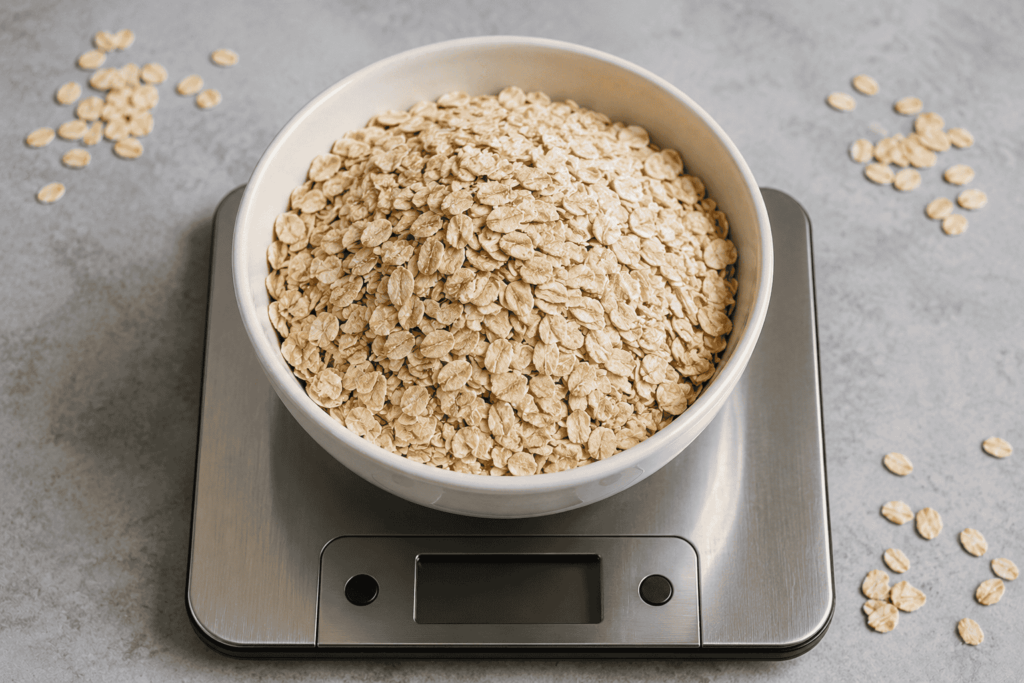
Visually, 100g of rolled oats fills about 1¼ standard measuring cups or forms a generous bowl of dry oats. It is enough to prepare a large serving of oatmeal or several portions for recipes such as overnight oats, muffins, or granola.
Compared with Common Household Items
If you don’t have a kitchen scale, you can estimate 100g of rolled oats using common kitchen measures:
- About 1¼ cups of dry rolled oats
- Approximately 12–13 level tablespoons
- Roughly enough to fill a medium-sized cereal bowl before adding liquid
These are general estimates and may vary slightly depending on the type of oats.
Dry vs Cooked Oats
It’s important not to confuse the weight of dry oats with cooked oats.
- 100g of dry rolled oats equals about 1¼ cups before cooking.
- After cooking with water or milk, the oats absorb liquid and produce about 2½–3 cups of cooked oatmeal, depending on the amount of liquid used.
Although the volume increases after cooking, the nutritional value remains based on the original 100g of dry oats.
100g of Oats in Cups, Tablespoons & Ounces
If you don’t have a kitchen scale, you can estimate 100g of oats using common kitchen measurements. The values below are based on dry rolled oats and may vary slightly for quick, instant, or steel-cut oats.
| Measurement | Equivalent to 100g |
|---|---|
| Cups | Approximately 1¼ cups |
| Tablespoons | About 12–13 tablespoons |
| Teaspoons | About 36–39 teaspoons |
| Ounces | Approximately 3.5 oz |
| Pounds | Approximately 0.22 lb |
Note: These measurements are approximate and are intended for dry oats. For the most accurate results when cooking, baking, or tracking nutrition, measure 100g using a kitchen scale.
Calories in 100g of Oats
A 100g serving of dry oats provides approximately 380–390 calories, making oats a nutrient-dense source of complex carbohydrates, fiber, and plant-based protein. The calorie content varies only slightly between different types of oats because they all come from the same whole grain. Cooked oats contain fewer calories per 100g because they absorb water during cooking.
Rolled Oats
100g of dry rolled oats contains approximately 389 calories. They also provide fiber, protein, and important minerals such as iron and magnesium, making them a popular choice for breakfast and baking.
Quick Oats
100g of quick oats contains about 385–390 calories. Although they are processed into smaller flakes for faster cooking, their nutritional value and calorie content are very similar to rolled oats.
Steel-Cut Oats
100g of dry steel-cut oats provides approximately 375–385 calories. They have a chewier texture and take longer to cook, but their calorie content is comparable to other oat varieties.
Cooked Oats
Once cooked with water, oats absorb liquid and become much heavier, which lowers the calorie content per 100g of cooked oats.
On average, 100g of cooked oatmeal contains about 65–75 calories, depending on the amount of water used during cooking. If prepared with milk or sweetened ingredients, the calorie content will be higher.
Nutrition Facts for 100g of Oats
A 100g serving of dry oats is rich in complex carbohydrates, dietary fiber, plant-based protein, and essential minerals. The values below are approximate for plain, dry oats and may vary slightly depending on the variety and brand.
| Nutrient | Amount (Approx.) |
|---|---|
| Calories | 389 kcal |
| Carbohydrates | 66.3 g |
| Protein | 16.9 g |
| Fat | 6.9 g |
| Fiber | 10.6 g |
| Sugar | 0.9 g |
| Iron | 4.7 mg |
| Magnesium | 177 mg |
| Phosphorus | 523 mg |
| Potassium | 429 mg |
| Zinc | 4.0 mg |
Note: These nutrition values are based on 100g of plain, dry oats. Actual values may vary slightly depending on whether you’re using rolled, quick, steel-cut, or instant oats, as well as the brand and any added ingredients.
How Much Does 100g of Oats Make When Cooked?
When cooked, 100g of dry oats absorbs liquid and expands significantly, producing a much larger serving. The final volume depends on whether you cook the oats with water or milk and how much liquid you use.
Cooked with Water
When prepared with water according to the package directions, 100g of dry oats makes approximately 2½–3 cups of cooked oatmeal. The oats become soft and fluffy as they absorb water during cooking.
Cooked with Milk
Cooking oats with milk produces a creamier texture but a similar final volume. 100g of dry oats typically yields about 2½–3 cups of cooked oats, although the exact amount depends on the type and quantity of milk used.
How Cooking Changes Weight
Oats become much heavier after cooking because they absorb liquid.
- 100g of dry oats weighs 100g before cooking.
- After cooking, the finished oatmeal usually weighs about 250–300g, depending on the amount of water or milk absorbed.
- While the weight and volume increase, the total calories and nutrients remain based on the original 100g of dry oats unless additional ingredients such as milk, sugar, or fruit are added.
100g of Oats Compared With Other Serving Sizes
The table below compares common dry oat serving sizes by their approximate volume and calorie content. Values are based on rolled oats and are intended as general estimates. Slight variations may occur with quick, instant, or steel-cut oats.
| Weight | Cups | Calories |
|---|---|---|
| 20g | About ¼ cup | 78 kcal |
| 30g | About ⅓ cup | 117 kcal |
| 40g | About ½ cup | 156 kcal |
| 50g | About ⅝ cup | 195 kcal |
| 80g | About 1 cup | 311 kcal |
| 100g | About 1¼ cups | 389 kcal |
| 150g | About 1⅞ cups | 584 kcal |
Note: These measurements are approximate for dry rolled oats. Different oat varieties and brands may vary slightly in volume, so using a kitchen scale is the most accurate way to measure servings.
Is 100g of Oats a Healthy Serving?
A 100g serving of oats can be a healthy choice, but whether it’s the right amount depends on your calorie needs, activity level, and health goals. It provides nearly 390 calories, along with fiber, complex carbohydrates, and plant-based protein, making it a filling and nutritious meal.
For Weight Loss
If you’re trying to lose weight, 100g of oats may be a large serving for one meal. Many people choose 40–60g of dry oats for breakfast to help manage calorie intake while still benefiting from the fiber and protein that promote fullness.
For Muscle Gain
For people aiming to build muscle or increase calorie intake, 100g of oats can be an excellent serving. It supplies plenty of complex carbohydrates for energy and nearly 17g of protein, making it a good base for meals paired with milk, yogurt, nuts, or protein-rich toppings.
For Breakfast
100g of oats makes a substantial breakfast that can keep you satisfied for several hours. It’s well suited for active individuals or those with higher energy needs, while people with lower calorie requirements may prefer a smaller portion.
Daily Fiber Intake
A 100g serving of oats provides about 10–11g of dietary fiber, which contributes a significant portion of the recommended daily intake for most adults. Including oats as part of a balanced diet can help support healthy digestion and promote lasting fullness throughout the day.
How to Measure 100g of Oats Without a Scale
If you don’t have a kitchen scale, you can estimate 100g of dry oats using measuring cups, tablespoons, or by visually comparing the amount. While these methods are convenient, a scale remains the most accurate option for cooking, baking, and tracking nutrition.
Using Measuring Cups
The easiest way to estimate 100g of rolled oats is with a measuring cup.
- Rolled oats: About 1¼ cups
- Quick oats: About 1⅛–1¼ cups
- Steel-cut oats: About ⅔–¾ cup
- Instant oats: About 1¼–1⅓ cups
These measurements are approximate and may vary slightly between brands.
Using Tablespoons
You can also use tablespoons if you don’t have measuring cups.
For 100g of rolled oats, you’ll need approximately:
- 12–13 level tablespoons
This method works well for small batches or when preparing recipes without a scale.
Estimating by Eye
A visual estimate can also be helpful in everyday cooking. 100g of rolled oats looks like a generous bowl of dry oats or about 1¼ measuring cups before adding liquid.
Although estimating by eye is convenient, the amount can vary depending on the type of oats and how they are poured. For the most consistent results, especially when following recipes or monitoring portion sizes, use a kitchen scale whenever possible.
Does the Type of Oats Affect the Weight?
Yes. Different types of oats occupy different amounts of space, even when they weigh the same. This is because each variety is processed differently, affecting its size and density. While the weight remains 100g, the cup measurement can vary depending on whether you’re using rolled, quick, steel-cut, or instant oats.
Rolled vs Quick Oats
Rolled oats are flattened into larger flakes, while quick oats are cut into smaller pieces and rolled thinner.
As a result:
- 100g of rolled oats is about 1¼ cups.
- 100g of quick oats is about 1⅛–1¼ cups.
Although their volume differs slightly, both provide similar calories and nutrients.
Steel-Cut vs Rolled Oats
Steel-cut oats are less processed and consist of chopped oat groats, making them denser than rolled oats.
For the same 100g weight:
- Steel-cut oats: About ⅔–¾ cup
- Rolled oats: About 1¼ cups
This difference is why recipes often specify the type of oats to use.
Instant Oats
Instant oats are steamed and rolled into very thin flakes, allowing them to cook quickly.
100g of instant oats measures roughly 1¼–1⅓ cups, though the exact volume may vary slightly between brands.
Why Measuring by Weight Is More Accurate
Cup measurements can change depending on the type of oats, flake size, and how tightly they’re packed. In contrast, 100g always weighs 100g, regardless of the variety.
For the most accurate results when cooking, baking, or tracking nutrition, use a kitchen scale instead of relying solely on measuring cups or tablespoons.
Common Mistakes When Measuring Oats
Measuring oats may seem straightforward, but a few common mistakes can lead to inaccurate portions, affecting both recipes and calorie tracking. Here are the errors to avoid.
Confusing Dry Oats with Cooked Oats
One of the biggest mistakes is mixing up dry oats and cooked oats. A recipe calling for 100g of dry oats is not the same as 100g of cooked oatmeal. Once cooked, oats absorb water or milk, increasing in both weight and volume while the total calories remain the same.
Measuring by Volume Instead of Weight
Using cups or tablespoons is convenient, but these measurements can vary depending on the type of oats and how they’re poured.
For the most consistent results, 100g should always be measured with a kitchen scale, especially when baking or tracking nutrition.
Using Packed Instead of Level Cups
Scooping and packing oats into a measuring cup can significantly increase the amount you use.
For the best estimate, fill the measuring cup loosely and level it off with a straight edge instead of pressing the oats down.
Assuming All Oat Varieties Weigh the Same
Not all oats have the same density. Rolled, quick, instant, and steel-cut oats can all measure differently in cups, even when they weigh 100g.
If a recipe specifies a particular type of oats, use that variety and measure by weight rather than volume to achieve the most accurate results.
Frequently Asked Questions
For dry rolled oats, 100g is approximately 1¼ cups. The exact volume may vary slightly depending on whether you’re using rolled, quick, instant, or steel-cut oats, so weighing them with a kitchen scale provides the most accurate measurement.
100g of dry rolled oats equals about 12–13 level tablespoons. This is a useful estimate when you don’t have a measuring cup or kitchen scale, though slight variations can occur between oat varieties.
100g of dry oats contains approximately 380–390 calories. Most plain rolled oats provide around 389 calories, along with complex carbohydrates, dietary fiber, healthy fats, and nearly 17g of protein.
When cooked with water or milk, 100g of dry oats produces approximately 2½–3 cups of cooked oatmeal. The final amount depends on the type of oats and the quantity of liquid used during cooking.
It depends on your individual calorie needs and activity level. 100g of oats is a substantial breakfast, providing nearly 390 calories and plenty of fiber and protein. It may be suitable for active individuals or those trying to gain weight, while people aiming for weight loss often choose a smaller serving of 40–60g.
Final Answer
100g of dry oats is approximately 1¼ cups or about 12–13 level tablespoons, making it a generous serving for breakfast, baking, or meal prep. This amount provides roughly 380–390 calories and is an excellent source of complex carbohydrates, dietary fiber, and plant-based protein, helping support energy and fullness. Keep in mind that the exact cup measurement varies slightly between rolled, quick, instant, and steel-cut oats because each type has a different density. For the most accurate results—especially when cooking, baking, or tracking nutrition—it’s always best to measure oats with a kitchen scale.
Pingback: Quinoa Dry vs Cooked Weight (About 3x Heavier) - purehealthmode