
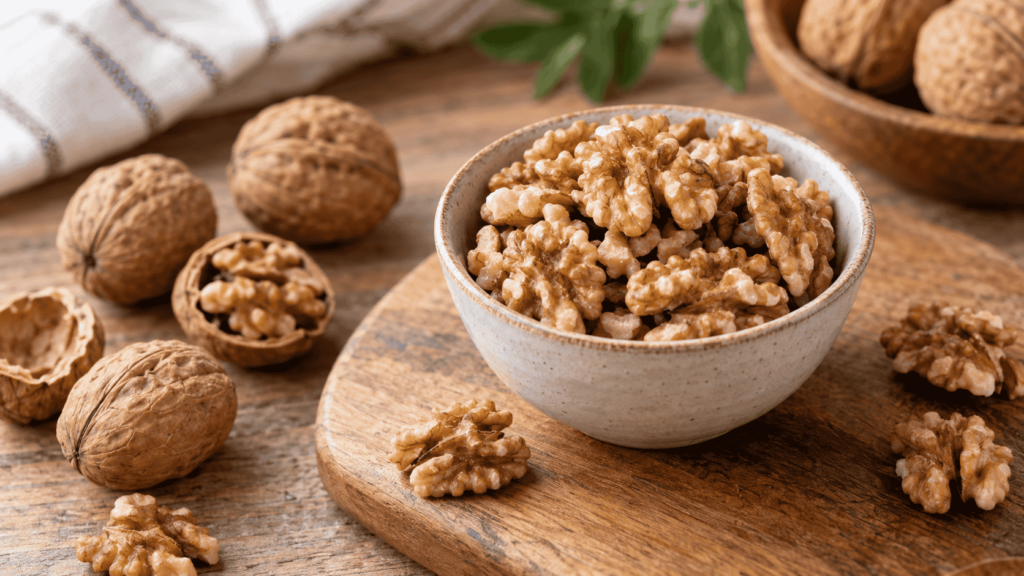
Quick Answer: 30g of walnuts is about 7 whole shelled walnut kernels or 14 walnut halves. That’s roughly 1.06 ounces and about ¼ cup, providing around 200 calories. The exact count varies since walnut sizes differ. Use the calculator below for whole kernels or halves.
Walnuts: Grams ↔ Count Calculator
Type in either box — the other updates automatically. Walnut size varies, so this is a practical estimate; weigh on a scale for exact portions.
Walnut Weight Conversion: Quick Reference Table
| Walnut Weight | Approx. Whole Walnuts | Approx. Walnut Halves |
|---|---|---|
| 10g | 2–3 | 5 |
| 15g | 3–4 | 7 |
| 20g | 5 | 9–10 |
| 25g | 6 | 12 |
| 30g | ~7 | ~14 |
| 40g | 9–10 | 18 |
| 50g | 11–12 | 23 |
| 100g | ~23–25 | ~46 |
These figures should be treated as estimates rather than exact conversions. Individual walnuts vary in size, and broken pieces can also change the number of pieces needed to reach a particular weight. Keep reading for ounce and cup conversions, full nutrition facts, and tips for measuring without a scale.
How Many Walnuts Is 30g?
For most people, 30 grams of shelled walnuts is roughly 7 whole walnut kernels. If you count the individual halves instead, the same amount is approximately 14 walnut halves.
A whole walnut kernel consists of two halves. Therefore, the number of pieces doubles when you count walnut halves instead of whole kernels.
How Many Whole Walnuts Are in 30g?
Approximately:
- 30g = 7 whole walnut kernels
- 30g = about 14 walnut halves
- 30g = approximately 1.06 ounces
These numbers are estimates rather than exact measurements. Walnut sizes differ, so seven particularly large walnuts could weigh more than 30g, while seven small kernels could weigh less.
It is also important to distinguish between a shelled walnut kernel and a walnut still inside its hard outer shell. When discussing food weight and nutrition, 30g generally refers to the edible walnut kernel rather than the entire walnut with its shell.
How Many Walnut Halves Are in 30g?
If you’re counting walnut halves, 30g is approximately 14 walnut halves.
This distinction is useful because walnuts are often sold or listed nutritionally as halves or pieces rather than complete whole kernels. Since approximately two halves make one whole walnut kernel, counting halves gives you roughly twice the number of pieces.
For example, if one whole walnut kernel weighs around 4g, its two halves together would also weigh around 4g. Therefore, seven whole kernels would contain approximately 14 halves.
The exact number can change depending on walnut size and whether the pieces are broken or unusually large. For precise portion control, weighing the walnuts is the better option.
What Does 30g of Walnuts Look Like?
If you don’t have a scale, it can be helpful to visualize 30g of walnuts.
A 30g portion is approximately:
- 7 whole walnut kernels
- 14 walnut halves
- A small handful
- Around a standard serving of nuts
For everyday eating, a small handful can be a convenient way to estimate a portion. However, visual estimates are not as accurate as weighing walnuts because people’s handfuls differ and walnut sizes are inconsistent.
If you’re simply adding walnuts to breakfast, oatmeal, yogurt, or a salad, counting around seven whole kernels can provide a useful estimate. But if you’re tracking calories closely, use a digital kitchen scale.
30g Walnuts in Ounces
30g of walnuts is approximately 1.06 ounces.
Grams and ounces are two different units commonly used for measuring food. Since one ounce is approximately 28.35g, 30g is just slightly more than one ounce.
Here’s a quick reference:
| Walnuts | Approx. Ounces |
|---|---|
| 15g | 0.53 oz |
| 30g | 1.06 oz |
| 50g | 1.76 oz |
| 100g | 3.53 oz |
So, if a recipe or nutrition plan calls for about 1 ounce of walnuts, 30g is a very close equivalent.
30g Walnuts in Cups
When measuring walnuts by volume, 30g is approximately 1/4 cup. However, the exact conversion depends on whether you’re measuring whole halves, pieces, or chopped walnuts.
Walnuts can have different amounts of empty space between pieces, so a cup measurement isn’t always identical from one preparation to another.
A general reference is:
| Amount | Approx. Weight |
|---|---|
| 1/4 cup walnuts | ~30g |
| 1/2 cup walnuts | ~60g |
| 3/4 cup walnuts | ~90g |
| 1 cup walnuts | ~120g |
If your walnuts are chopped, they may fit differently into a measuring cup than whole walnut halves. The way the walnuts are packed can also affect the final weight.
For recipes, a cup measurement may be perfectly practical. But when you’re trying to measure an exact 30 grams of walnuts, a kitchen scale is more reliable.
30g Walnuts in Tablespoons
If you don’t have a scale or measuring cup, tablespoons provide another rough way to estimate a walnut portion.
30g of walnuts is approximately around 3 tablespoons, depending on whether the walnuts are whole, halved, or chopped and how tightly they are packed.
Because walnut pieces have irregular shapes, tablespoon measurements are less precise than weighing. Chopped walnuts may occupy a different volume compared with large walnut halves.
If you’re preparing a recipe, tablespoons can be convenient. For calorie tracking or a specific nutrition target, however, weighing the walnuts is the best approach.
30g Walnuts Calories
30g of walnuts contains roughly 195–200 calories, depending on the exact nutritional composition of the walnuts.
Walnuts are relatively calorie-dense because they contain a substantial amount of fat. They also provide protein, carbohydrates, and fiber, which contribute to their overall nutritional value.
The calorie content is not necessarily a reason to avoid walnuts. Instead, portion size is important. Because walnuts are energy-dense, eating a measured serving can make it easier to understand how many calories you’re adding to your diet.
For example, adding around 30g of Walnuts can be added to oatmeal (check our guide to see How Much Is 100g of Oats?) or yogurt can provide flavor, texture, and nutrients. Eating directly from a large bag, on the other hand, can make it easier to consume a much larger portion without noticing.
Remember that exact calorie values can vary between products, so check the nutrition label when a specific brand or product is being used.
30g Walnuts Nutrition Facts
A 30g serving of walnuts provides a combination of fats, protein, carbohydrates, and fiber.
| Nutrient | Approximate Amount in 30g |
|---|---|
| Calories | ~200 kcal |
| Protein | ~4–5g |
| Total fat | ~20g |
| Carbohydrates | ~4g |
| Fiber | ~2g |
| Sugar | ~1g |
Protein
Walnuts provide some plant protein, with around 4–5g of protein in 30g according to the reference profile above. They can contribute to overall protein intake, although walnuts are primarily valued as a source of fats rather than as a high-protein food. For other protein-rich options, see our guide to Soft Protein Foods After Oral Surgery.
Healthy Fats
A large proportion of the calories in walnuts comes from fat. Walnuts contain substantial amounts of unsaturated fats, making them a nutrient-dense addition to many balanced diets.
Fiber
A 30g serving provides approximately 2g of fiber. Fiber contributes to the overall nutritional value of walnuts and can help make a serving more satisfying.
The exact nutrition values may vary depending on the product and serving size, so the nutrition label is the best source for a specific packaged product.
Is 30g of Walnuts a Serving?
Yes, 30g is approximately a standard serving size commonly used for nuts, although serving recommendations can vary.
Using a consistent portion can be useful for several reasons. It can help you control portions, make calorie tracking easier, provide a consistent amount for recipes, and make nutrition comparisons simpler.
For many people, measuring approximately 30g can be an easy way to enjoy walnuts without needing to estimate a large handful.
If you’re following a particular nutrition plan, however, your ideal portion may be different depending on your overall dietary needs and calorie intake.
How Many Walnuts Should You Eat a Day?
There isn’t one number of walnuts that everyone must eat each day. How many walnuts you should eat depends on your overall calorie intake, dietary pattern, personal nutritional needs, and how walnuts fit into your meals and snacks.
For many people, around 30g is a practical portion. This gives you approximately seven whole walnut kernels or 14 halves while keeping the serving relatively consistent.
You can enjoy walnuts as a snack or add them to foods such as oatmeal, yogurt, salads, or other meals.
The important point is to consider walnuts as part of your overall diet rather than focusing only on a specific number of pieces.
30g Walnuts for Weight Loss
Walnuts can fit into a weight-loss diet, but portion size matters because they are relatively high in calories.
A measured 30g serving can be easier to include in a calorie-controlled diet than eating walnuts directly from a large bag. Measuring your portion allows you to know approximately how many calories you’re consuming.
You can also combine walnuts with other nutritious foods. For example, try adding them to:
- Oatmeal
- Greek yogurt — see our measurement guide, How Many Grams in a Cup of Greek Yogurt?
- Fresh fruit
- Salads
- Smoothies or breakfast bowls
Walnuts don’t automatically cause weight loss, but a controlled serving can be part of a balanced, calorie-conscious eating pattern.
How to Measure 30g of Walnuts Without a Scale
If you don’t have a kitchen scale, there are several ways to estimate 30g of walnuts.
Method 1: Count the Walnuts
Count approximately 7 whole shelled walnut kernels. This is a simple option when you’re eating walnuts as a snack.
Method 2: Count the Halves
You can count approximately 14 walnut halves. Remember that two halves are roughly equivalent to one whole walnut kernel.
Method 3: Use a Measuring Cup
Use approximately 1/4 cup of walnuts as a rough volume measurement.
All three methods are estimates. Walnut size, shape, and packing can change the actual weight. If precision matters, particularly for calorie or nutrition tracking, a digital kitchen scale is the most accurate choice.
Frequently Asked Questions
Approximately 7 whole shelled walnut kernels are 30g. If you’re counting individual halves, that’s about 14 walnut halves.
There are approximately 14 walnut halves in 30g. The exact number can vary depending on the size of the walnut halves.
A 30g serving of walnuts contains approximately 200 calories. Exact calories can vary depending on the product and its nutritional composition.
No. 30g is a moderate, commonly used serving size for nuts. It is approximately seven whole walnut kernels or 14 halves.
30g of walnuts is approximately 1/4 cup, although the exact conversion can change depending on whether the walnuts are whole, halved, chopped, or packed tightly.
30g is approximately 1.06 ounces. This means 30g is just slightly more than one ounce.
A shelled walnut kernel weighs roughly 4g on average, although individual walnuts can be larger or smaller. This is why approximately seven walnuts make 30g.
Two walnut halves make approximately one whole walnut kernel. Therefore, when you count halves, the number of pieces is roughly double the number of whole walnut kernels.
Final Answer
30g of shelled walnuts is approximately 7 whole walnut kernels or about 14 walnut halves. It is roughly 1.06 ounces and around 1/4 cup, although the exact amount can vary depending on walnut size and how the walnuts are measured. A 30g serving provides roughly 200 calories, along with healthy fats, protein, fiber, and other nutrients. If you need an exact 30g portion for calorie or nutrition tracking, the most reliable method is to weigh the walnuts using a kitchen scale.