
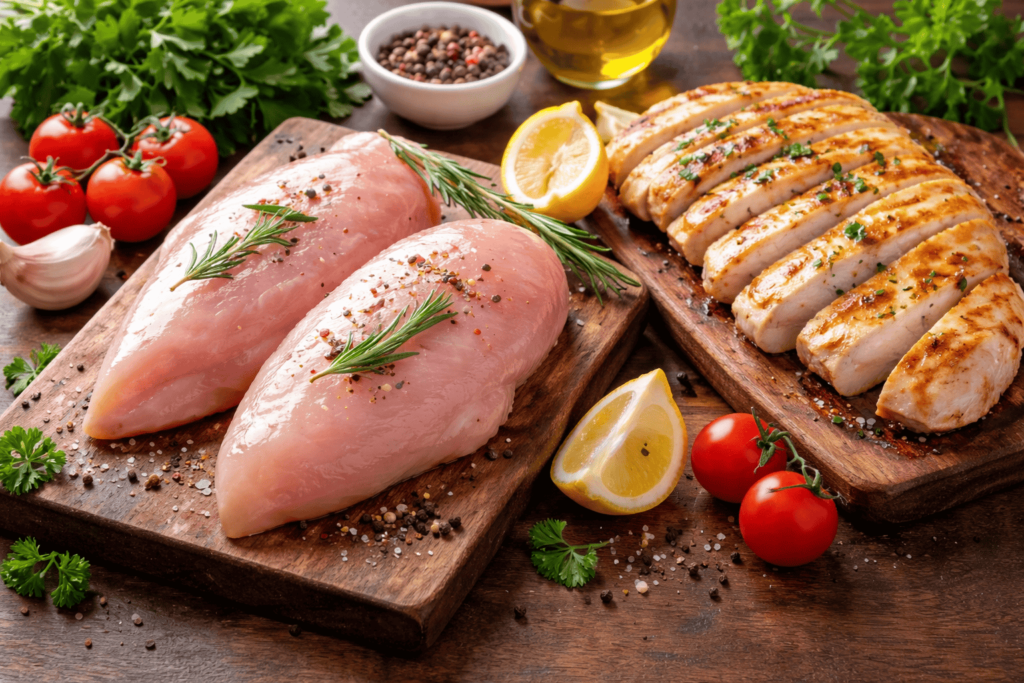
Quick Answer: A raw chicken breast loses about 20–30% of its weight when cooked, mostly from water loss. A 200g raw breast typically cooks down to around 150g, and a 100g raw portion becomes about 70–75g cooked. Use the calculator below to convert any raw weight to its cooked equivalent.
Chicken Breast Raw ↔ Cooked Weight Calculator
Type in either box — the other updates automatically. Shrinkage varies by cooking method, heat level, and chicken size; treat this as a practical estimate, not an exact figure.
Chicken Breast Raw vs Cooked Weight: Quick Conversion Table
| Raw Weight | Cooked Weight |
|---|---|
| 100g | 70–75g |
| 150g | ~110g |
| 200g | ~150g |
| 250g | ~180g |
These figures assume a typical 20–30% shrinkage from cooking. Keep reading for a breakdown by cooking method, chicken breast size, and how this affects calorie and protein tracking.
How Much Does Chicken Breast Weigh Raw vs Cooked?
Chicken breast weight can vary depending on size, cut, and source. On average, a raw boneless, skinless chicken breast weighs between 120g and 250g. However, once cooked, that weight drops significantly.
After cooking, a chicken breast typically weighs around 90g to 180g, depending on the method used. This reduction happens because chicken contains a large amount of water, which evaporates during cooking.
Key Insight
Most chicken breasts lose about 20–30% of their weight when cooked. This means:
- 100g raw → ~70–75g cooked
- 200g raw → ~150g cooked
This simple understanding forms the base for accurate meal tracking and helps avoid underestimating calorie intake.
Chicken Breast Sizes Explained (Small, Medium, Large)
Chicken breast weight varies significantly depending on the size of the chicken and how it’s cut. Understanding these variations helps you estimate portions more accurately, especially when you don’t have a scale.
Small, Medium, and Large Chicken Breasts
- Small chicken breast: 120g – 150g (raw)
- Medium chicken breast: 150g – 200g (raw)
- Large chicken breast: 200g – 250g (raw)
After cooking, each size reduces by approximately 20–30%, meaning a large raw chicken breast may shrink to around 150–180g cooked.
Chicken Breast Weight Loss Percentage When Cooked
Cooking causes noticeable shrinkage in chicken breast, and this is mainly due to moisture loss. Understanding this percentage is crucial for calculating accurate portion sizes.
Why Chicken Loses Weight
Chicken breast is made up of approximately 65–75% water. When heat is applied:
- Water evaporates
- Muscle fibers tighten
- Some fat melts (minimal in breast meat)
This results in a smaller, denser piece of meat.
Average Shrinkage by Cooking Method
Different cooking methods lead to different weight losses:
- Grilling: 20–25% shrinkage
- Baking: 25–30% shrinkage
- Frying: up to 30%+ shrinkage
Grilling tends to retain more structure, while frying removes more moisture and sometimes adds fat.
How Cooking Temperature Affects Chicken Breast Weight
Cooking temperature plays a major role in how much weight chicken loses. Higher heat leads to faster moisture loss, while lower heat helps retain juiciness.
High Heat vs Low Heat Cooking
- High heat (grilling, frying): Causes rapid water evaporation → more shrinkage
- Low to medium heat (baking, slow cooking): Retains more moisture → less weight loss
Overcooking at high temperatures can push shrinkage beyond 30%, leaving the chicken dry and significantly lighter. Proper temperature control not only improves taste but also helps maintain accurate portion sizes.
Does Freezing Chicken Affect Weight After Cooking?
Freezing and thawing chicken can slightly affect its water content.
Impact of Freezing
- Some moisture may be lost during thawing
- Slightly higher shrinkage during cooking
- Texture may change slightly
However, the overall difference is minimal and does not significantly affect nutrition tracking.
Quick Chicken Weight Conversion Chart (Printable)
For quick reference, having a simple conversion chart can make meal prep much easier. This is especially useful if you regularly track calories or prepare meals in bulk.
Easy Conversion Guide
- 100g raw → 70–75g cooked
- 150g raw → ~110g cooked
- 200g raw → ~150g cooked
- 250g raw → ~185g cooked
- 300g raw → ~225g cooked
- 350g raw → ~260g cooked
- 400g raw → ~300g cooked
- 450g raw → ~340g cooked
- 500g raw → ~375g cooked
You can save or screenshot this chart and use it whenever needed. Over time, you’ll start estimating portions without needing to calculate every time.
Should You Weigh Chicken Raw or Cooked?
This is one of the most debated questions in fitness and nutrition.
Best Practice: Weigh Raw
The most accurate method is to weigh chicken before cooking. This is because:
- Nutrition labels are based on raw weight
- It ensures consistency
- Easier to track macros accurately
When Cooked Weighing Is Acceptable
There are situations where weighing cooked chicken is practical:
- Meal prep in bulk
- Eating outside or pre-cooked meals
- Tracking leftovers
However, if you weigh cooked chicken, you must use conversion factors to avoid errors.
How to Measure Chicken Without a Scale (Practical Guide)
Not everyone has access to a kitchen scale, but that doesn’t mean you can’t estimate chicken portions reasonably well.
Simple Visual Estimation Methods
- Palm size method: One palm-sized chicken breast ≈ 100–120g cooked
- Hand comparison: Thickness and width of your hand gives a rough portion idea
- Common kitchen estimates: A medium chicken breast ≈ 1 cup chopped cooked chicken
While these methods are not as precise as weighing, they are useful for maintaining consistency when a scale is unavailable.
How to Convert Raw Chicken to Cooked Weight (Simple Formula)
Instead of memorizing tables, you can use a simple formula:
Cooked weight = Raw weight × 0.75
Example
- 200g raw chicken → 150g cooked
- 150g raw → ~112g cooked
This formula assumes a 25% shrinkage, which is a reliable average for most cooking methods.
Calories & Protein: Raw vs Cooked Difference
One common misunderstanding is that cooking reduces protein or calories. That’s not true.
What Actually Changes?
- Water decreases
- Nutrients stay mostly the same
- Density increases
Example Comparison
- 100g raw chicken = ~120 calories
- 100g cooked chicken = ~165 calories
This doesn’t mean cooked chicken has more calories—it just means the same nutrients are packed into less weight.
For protein-focused diets, this matters a lot. If you’re calculating protein intake like in How Much Protein in One Shrimp? or Egg protein guide for 30g,40g & 50g, accuracy in weight becomes critical.
How Many Grams of Protein in a Chicken Breast?
| Amount (Boneless, Skinless) | Protein | Calories (Approx.) |
|---|---|---|
| 100g raw | ~22.5g | ~120 kcal |
| 100g cooked (roasted) | ~31g | ~165 kcal |
| 4 oz (113g) raw | ~25g | ~136 kcal |
| 4 oz (113g) cooked | ~35g | ~187 kcal |
| Small breast (120–150g raw) | ~27–34g | ~145–180 kcal |
| Medium breast (150–200g raw) | ~34–45g | ~180–240 kcal |
| Large breast (200–250g raw) | ~45–56g | ~240–300 kcal |
An average medium chicken breast has about 40g of protein, whether you weigh it raw or cooked, because cooking removes water, not protein. The difference is per 100g: cooked chicken has more protein per gram simply because it weighs less. Skin-on breasts add fat and calories but little extra protein.
Chicken Breast Weight for Bodybuilding & High-Protein Diets
For those focused on fitness, understanding chicken weight is critical for hitting daily protein targets.
Protein Tracking Accuracy
A typical chicken breast provides around 25–30g protein per 100g cooked weight. If you miscalculate cooked vs raw weight, your protein intake may fall short.
For example:
- 200g raw chicken → ~150g cooked
- Protein intake ≈ 40–45g
This is why bodybuilders prefer weighing raw chicken—it ensures precise macro tracking and consistent results over time.
Why This Matters for Diet, Fitness & Weight Loss
Understanding chicken breast weight raw vs cooked difference is not just technical—it directly impacts your results.
For Weight Loss
If you underestimate calories due to incorrect weighing, you might:
- Eat more than planned
- Slow down fat loss
- Miscalculate daily intake
If you’re aiming for weight loss, our 1500-calorie guide can help you stay on track.
For Muscle Building
For muscle building, accurate protein intake is critical. If you believe you are consuming 150g of protein daily but are actually under-eating due to incorrect raw vs cooked tracking, your muscle growth and recovery can be negatively affected.
Consistency also matters in meal planning. Just like maintaining accuracy in carbohydrate portions using guides such as How Many Slices of Bread Is 100g?, keeping chicken measurements consistent ensures your nutrition stays balanced and predictable.
How Much Chicken Do You Need Per Person? (Meal Planning Guide)
Planning meals becomes easier when you know how much chicken to prepare per person.
Standard Portion Guidelines
For example:
- Average serving: 120–150g cooked chicken
- Raw equivalent: ~160–200g per person
For weekly meal prep:
- 5 meals × 150g cooked = 750g cooked
- Requires ~1kg raw chicken
This helps avoid under-preparing or wasting food
Cooking Methods and Their Impact on Weight
Different cooking techniques affect both weight and nutrition.
Grilling
Grilling is one of the best methods:
- Moderate shrinkage
- Retains protein
- Minimal added fat
Baking
Baking causes slightly more water loss:
- More shrinkage than grilling
- Even cooking
- Good for meal prep
Frying
Frying has the highest impact:
- Maximum shrinkage
- Added fat increases calories
- Less ideal for weight loss
Skin-On vs Skinless Chicken Weight Difference
The presence of skin affects both weight and calorie content.
Key Differences
- Skinless chicken: Lower fat, more predictable shrinkage
- Skin-on chicken: Higher fat content, slightly less shrinkage due to fat retention
However, skin adds significant calories, so most diet plans prefer skinless chicken for better control.
Boneless vs Bone-In Chicken Weight Comparison
Bone-in chicken cuts can be misleading when measuring portions.
Understanding Edible Weight
For example:
- Bones can make up 20–30% of total weight
- A 250g bone-in piece may yield only 170–200g edible meat
For accurate tracking, always consider the edible portion rather than total weight.
If you want to make the most out of the leftover bones instead of wasting them, you can turn them into a nutritious stock. Our guide on How to Make Bone Broth explains a simple method to extract minerals, collagen, and flavor from bones while reducing food waste.
Common Mistakes People Make
Even experienced dieters make mistakes when tracking chicken.
Mixing Chicken Breast Raw and Cooked Weights
One of the most common errors is switching between raw and cooked measurements. For example, tracking raw chicken on one day and cooked chicken on another leads to inconsistent calorie and protein data. This makes it difficult to stay accurate with your diet goals.
Ignoring Shrinkage
Many people assume chicken weight stays the same after cooking, but it actually loses 20–30% of its weight due to water loss. Ignoring this shrinkage leads to underestimating calorie intake and can affect both fat loss and muscle gain results.
Using Incorrect Databases
Nutrition apps are not always consistent—some show values for raw chicken, while others use cooked data. Mixing these without checking the source can create confusion and tracking errors in your daily intake.
Not Measuring Chicken Breast Raw and Cooked Properly
Estimating portions by eye instead of using a kitchen scale often leads to major inaccuracies. Even small misjudgments can add up over time and impact your overall nutrition balance.
Pro Tips for Accurate Food Tracking
To avoid mistakes, follow these simple strategies:
- Always weigh chicken raw when possible
- Use a digital kitchen scale
- Stick to one method consistently
- Track cooking method (grilled, baked, fried)
- Use conversion formulas if needed
These habits will dramatically improve your diet accuracy.
Quick Summary
- Chicken breast loses about 20–30% weight when cooked
- 100g raw becomes ~70–75g cooked
- Always weigh raw for best accuracy
- Calories don’t increase—only density changes
Raw vs Cooked Chicken Breast Weight for Other Meats (Comparison Guide)
Chicken is not the only meat that changes weight during cooking. Understanding other meats can give you a broader perspective.
Shrinkage Comparison
- Beef: 25–30% weight loss
- Fish: 15–25% weight loss
- Turkey: 20–30% weight loss
Each meat behaves differently, but the principle remains the same—water loss leads to reduced weight and higher nutrient density after cooking. This is especially important in meal planning, where portion accuracy matters. For example, if you’re tracking poultry portions more precisely, our guide on How Many Slices of Turkey is 2 Oz? can help you easily estimate servings without a kitchen scale.
For rice pairing, this becomes especially useful when planning meals alongside foods like rice. For example, pairing chicken with rice measured accurately—like in How many grams in a cup of rice—helps maintain precise calorie control.
Final Thoughts: Chicken Breast Weight Raw vs Cooked
Understanding the chicken breast weight raw vs cooked difference is a simple but powerful step toward better nutrition tracking. Whether your goal is weight loss, muscle gain, or general health, accurate measurement helps you stay consistent and avoid hidden mistakes.
By using conversion tables, simple formulas, and consistent weighing habits, you can ensure your calorie and protein intake is always on point. Don’t overcomplicate it—just pick a method, stick to it, and track smartly. Over time, this small habit can lead to big improvements in your results.
Frequently Asked Questions
No. Cooked chicken weighs less due to water loss, so 100g cooked contain more concentrated nutrients.
No, protein remains almost the same. Only water content decreases.
Typically around 20–30%, depending on the cooking method.
Raw is more accurate because nutrition labels are based on raw weight.
Because water is lost, making nutrients more concentrated.
Usually between 120g and 180g depending on its raw size.
Pingback: Beef Raw vs Cooked Weight (About 25% Loss) - purehealthmode
Pingback: How Many Chicken Nuggets Is 100g? (5-6 Nuggets) - purehealthmode